












http://www.pambazuka.org/images/articles/307/blogs_01_koranteng.gif publishes his letter to the UK Daily Telegraph complaining about plagiarism from excellent blog post 'Bags and Stamps'. Bags and Stamps is not about the plastic shopping mall type of bag but the ubiquitous 'plaid' plastic bags that can be seen from London to Joburg and from New York to Manila. Telegraph writer, Liz Hunt obviously came across his post and chose to blatantly steal Koranteng’s words and those of another blogger and blog comments. He provides a comparison table between his post and the Telegraph piece – incidentally she didn’t even bother to match the correct spelling and missed the nuances left by various comments.
'Do note that the author completely misses Georgia's nuance by transposing Trinidad to Guyana. The point is that the naming is done by the natives - looking down onto the teeming masses of refugee or downtrodden immigrant Others. Thus Nigerians named the bags Ghana must go, Germans named it Tuekenoffer, and so forth. Thus this is not a simple copying and pasting, there was reordering and some conscious editing done in the article and perhaps the immigrants coalesced into one indistinguishable mass. This is of a piece with the general disdain for said immigrants that the rest of the author's commentary indicates. We can also skip over how Boston becomes America in the coining of "Chinatown tote". The rest of the article I'll suggest is equally enlightening.'
http://www.pambazuka.org/images/articles/307/blogs_02_dibussi.gifDibussi’s Den on 'Europe’s Shame' as African immigrants are left in the sea for three days and nights holding on to a tuna fishing net. The captain of the tug towing the net refused to allow them on board his ship. One of the comments left on the post expresses the disinterest of African leaders in the constant outward flow of the continent’s skills, knowledge and workforce.
'I saw this dramatic rescue on TV and melted at the desperation of fellow Africans.This is so sad. I continue to be amazed at the nonchalance of our African rulers. They have no shame and seem not to be bound by any impulse of collective responsibility to do something about the continuous haemorrhaging of the continent’s very best. Soon, Africa is going to skip a whole generation as the gap widens with the young all fleeing the sinking ship.'
http://www.pambazuka.org/images/articles/307/blogs_03_ekosso.gifRosemary Ekosso describes the last weeks of former World Bank head, Paul Wolfowitz as being like an animal holding on to grass to 'avoid being washed away by water'.
'We all saw how Mr. Paul Wolfowitz, (now, thankfully, former) head of the World Bank, held grass for weeks after it was brought to public notice that he was embroiled in a sordid scandal involving a female companion. Well, Mr. Wolfowitz was swept away by the flood of public opinion. And now the US government is offering to replace him with someone who is, as evidenced by the article below, even worse, especially for the Third World.'
Any relief at Wolfowitz departure is offset by the possibility of an even worse replacement, Robert Zoellick of WTO fame. Jubilee Research describes him as 'the tireless champion of free trade, but Robert Zoellick the promoter of American interests by any means and at any cost – especially to developing countries'.
http://www.pambazuka.org/images/articles/307/blogs_04_chipla.gifChippla's Weblog posts an interesting piece on the recent Kenya Airways crash in Cameroons. A reader of his blog, Bert, speculates that the Captain was under pressure from his superiors to get the plane back to Nairobi as soon as possible. Whether the newly qualified 1st officer disagreed with the Captains decision to fly may never been known but even if he did, what chance did he have of questioning the authority of the Captain and the higher echelons of KA? A similar situation happened in 1977.
'Bert also made mention of the worst aviation disaster in history—the 1977 Tenerife disaster between two Boeing 747s belonging to KLM and Pan Am—and how the unchallenged faulty decision of the KLM flight captain resulted in the death of almost 600 people. Voice transcript of this incident (as made available on Wikipedia) shows how foggy weather and the misinterpretation of communication with the control tower led the seasoned KLM flight captain to initiate take off despite questions from his flight engineer.'
Chippla’s point is that we live in a 'world where authority is recognised' but how do we challenge that authority in cases like these crashes? Should we have any influence as passengers/consumers on the Captains or any authorities decisions?
http://www.pambazuka.org/images/articles/307/blogs_05_david.gifDavid Ajao’s Blog is excited by the entry into the African blogosphere of Black South African blogger - Israel Mlambo. The fact that such an entry is worthy of it’s own post and celebration says it all.
'it is with pleasure that I introduce to you, a black South African blogger, Israel Mlambo. He blogs at http://izzonline.blogspot.com * You should read another of his blog post 'The SA blogosphere is ‘entirely’ white' to understand why I emphasised the word “black”.' – More on Israel in the Southern African review.
http://www.pambazuka.org/images/articles/307/blogs_06_wordsbody.gifWordsbody celebrates this year’s Orange Prize to be announced on the 6th June. Here she goes back to 2004 when Andrea Levy won the prize for a novel 'Small Island' and Nigeria's Chimamanda Ngozi Adichie had been shortlisted for her debut novel, Purple Hibiscus. This year Adichie is once again a nominee for her latest novel Half of a Yellow Sun. Excellent write up and I look forward to this year's edition.
http://www.pambazuka.org/images/articles/307/blogs_07_blacklooks.gifBlack Looks listens to a speech by Nigeria’s former finance minister, Ngozi Okonjo-Iweala – part of the TED Africa hooray taking place this week in Arusha, Tanzania. A gathering of technologists, entertainers and designers (TED!) from across Africa and beyond with the hope of creating a 'A Different Africa'. No AIDS, poverty, shackdwellers, conflict, human rights violations or limits on press freedom, here. The focus is on business and 'doing it for ourselves'. BL comments
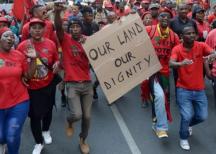
'One thing I do agree with is “We have to do it for ourselves”. The Abahlali baseMjondolo shack dwellers have shown us and proved that a social movement can engage in real participatory democracy and stand up to oppression, elitism, BEE (Black Economic Empowerment) for the few, racism and economic apartheid. People get very excited when talking about this “other Africa” - the one of growth in telecoms and of course huge profits, most of which are made from the poor subsidising the rich (cheaper tariffs and better deals for contract versus “pay as you go”). Privatisation policies which include privatisation of basic needs such as water, and electricity and again the poor subsidising the rich who pay less for their electricity than the poor and commercial enterprises being subsidised by consumers. And the big wow - Nigeria now has a shopping mall where businesses are turning over 4 times more than projected. Hows that for progress? Especially when it runs on its own private set of generators and God knows where it gets its water from? And even more exciting is the new “mining code” legislation which would be a great leap forward except it has somehow now reached the oil industry. But with all these great leaps forward where is the money going - not into social programmes, not in constructing an electric power system and running water.'
- Log in to post comments
- 1435 reads
Author

Anonymous (not verified)