













This week, Dibussi Tande reviews blogs on , a relatively new blogging and communication platform specifically designed for the sub-Saharan blogger and writer. According to its founders, Maneno 'allows those with limited or narrow-bandwidth internet to use a system that is lightweight and straightforward in functionality'.
 cc Maneno
This week, we will review blogs on Maneno , a relatively new blogging and communication platform specifically designed for the Sub-Saharan blogger and writer. According to its founders, Maneno “allows those with limited or narrow-bandwidth internet to use a system that is lightweight and straightforward in functionality.” Most significantly, the site content and interface is translated into many languages “to remove linguistic barriers that are being seen more and more in a growingly Anglophonic web.”
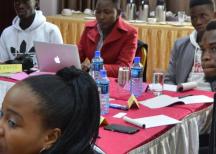
Subsaharska, a technology and travel blog, explains how the idea for “BarCamp Africa UK 2009”, an “un-conference” focusing on “Moving away from Aid to Technology Driven Development in Africa”, was hatched on Twitter:
“These things always start small enough. One twit begets another twit which then begets an official site and before you know it, a barcamp is ready to happen. Such was the case leading up to the BarCamp Africa UK which is happening November 7th in London.
Ethel Cofie started the twit about having a BarCamp Africa in the UK as to date there hasn't been one. Quickly the movement gathered a great deal of steam and a number of other people signed on as organizers…
The organizers are mostly a group of Ghanaians and I was curious if there was a direct focus to the event, as sometimes a barcamp will have one. Ethel told me that they are much the same as other BarCamp Africa events which are to foster connections, grow ideas, and showcase success stories… I still can't get over how our social technologies allow something that starts out as a musing thought to morph in to a full-fledged event in a matter of just a few weeks.”
General Topics on Social Science, a blog that deals with African affairs, has a 4-part posting on the life of Samori Toure, the Warrior King who founded the Wassoulou empire and resisted French imperialism:
“Samori Toure was important because he was an African leader who defeated the European colonial masters on numerous occasions before his capture. He was a master of military tactics and brilliantly organized the empire that he controlled. But more than anything else, he was, and is, a symbol. He is a symbol of defiance and strength in the face of overwhelming odds. Overwhelming odds that many African peoples find themselves in today in the face of modern day colonialism and exploitation.
Throughout colonialism and post-colonialism, Africa’s colonial masters made great efforts to hide the exploits of many of our leaders from us. African children were taught that they were monkeys with inferior intelligence to whites and that all of our great leaders such as Samori were just ruthless savages. As the renowned African historian Basil Davidson notes, “Men like al Hajj Umar appear in the European story as nothing more than wild fanatics or frantic nuisances; leaders like Samory as bloodthirsty bandits or mere adventurers. In truth, these men responded, as outstanding leaders always will, to the most profound movements of social need and thought of their time” (Davidson, 1964; pg. 268).”
Madame Toubab expresses her frustrations at the continued negative portrayals of Africa in the Western media:
“I guess many (all?) of you have already been frustrated by the way African countries and people are represented in the Western media, and it is only because I am a neophyte in this affairs that I find the issue particularly poignant. Does one every get used to this manipulation of languages, images, and discourses? I can't say. All I know is that it makes me angry to witness in my work, day after day, how Senegal, Senegalese people, and in particular Senegalese migrants are misrepresented in the newspapers... One of the things that I find particularly disturbing is that even professionals with international reputation such as J. Bauluz, the one and only Spanish Pulitzer Prize, are making their career on the endless repetition of the same stereotypes, the same victimization, the same blood-and-pus-and-corpses-floating-in-the-sea images, the same death that we've always seen. Even when those who talk and write claim to be talking a different take on the issue, the result is the same.”
Twiga writes about a visit to a market in the Ghanaian border town of Osseikro:
“During my first week in Abengourou I took a quick trip to the Ghanaian border at Niablé, which is only about 20km away, with some colleagues who needed to do some shopping. Apparently import taxes in Ghana are lower than in Côte d'Ivoire, so many products in Abengourou's stores arrive via Ghana. To cross the border for the day no visa is required, so it's quite popular to go shopping there. The first town right after crossing the border is Osseikro (or Osseikadiokro), which is basically a little market on a road with a few houses around it. Most stores seem to sell the same products, the most popular being bicycles, kente cloths and all sorts of crappy Chinese-made household stuff such as kitchen implements.
However, I found one interesting store in this repetitive border market (it's not big, so I looked at every single shop): a Ghanaian sandalmaker. Actually, the whole market is Ghanaian (although everybody spoke French), but this was the only store selling handmade stuff. Apparently these types of sandals are called ahenemaa and are traditionally reserved for Akan chiefs. Maybe that would explain why nobody was paying any attention to the shop, which also served as a sandal-making workshop as you can see below.”
Konakry Express revisits the September 28 massacre in Guinea by reproducing a call by the Council of the Intellectuals of Africa and the African Diasporas for the creation of an African commission of inquiry:
“Whereas, on Monday September 28, 2009, Africa and the whole world waited to live again and reinforce the historic Non of Guinea to French colonialism and General Charles de Gaulle, that powerful resounding Non that had come a year after the Independence of Ghana in 1957, and had given a strong signal of the political emancipation of the French ex-colonies of Africa from the yoke of the old colonial power. Alas…instead of the celebration of the honor and dignity found in that Non, it is a disaster which was unrolled in the first independent French-speaking country in Africa…
Whatever the reasons, the immediate actions of the actors of this day make this September 28, 2009 more a time of nightmare and tragedy than a celebration… It is a PROVOCATION intended to push the Guineans in a contrary direction against their objective and subjective interests, but also it is an INSULT to Africa and the conscience of Africans, just at the moment when the question of the United States of Africa is at the forefront of our thinking.”
Canchas 2010, another Maneno blog which focuses on human stories around makeshifts soccer fields, displays pictures of kids playing soccer in the streets of Abidjan:
“A couple of weekends ago, I had the chance to be guided through the streets of the popular Adjame market in Abidjan by a friend who lives there. I really enjoyed our Sunday afternoon walk, and not only because I love street markets, but also because there were a lot of other things happening in the street. Such as football games on every block. Here are a few of them, including a poster of the 2010 World Cup in the background”.
* Dibussi Tande, a writer and activist from Cameroon, produces the blog Scribbles from the Den.
* Please send comments to [email protected] or comment online at Pambazuka News.
- Log in to post comments
- 823 reads
Author

Anonymous (not verified)