
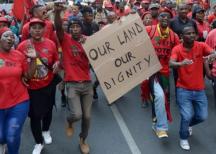


















Fifty years ago, 69 Africans protesting against pass laws were shot in the South African township of Sharpeville. Posts in this week’s round-up of the blogosphere remember the massacre, the life of activist Fatima Meer and bring to mind the continuing struggle for the right to decent housing by shackdwellers movement, Abahlali baseMjondolo. They also include musings on migration, Haiti and headscarves.
http://www.pambazuka.org/images/articles/475/blog/march24_01_africa_is.gifAfrica is a Country comments on a documentary ‘Living with Illegals’ by Sierra Leone/British journalist Sorious Samura who becomes an ‘illegal’ himself. Sean Jacobs questions the ethics and truthfulness of the film but like Samura, he ends up rooting for the migrants who are ‘ready to do anything’ in Euroland:
http://www.pambazuka.org/images/articles/475/blog/march24_01_video.gif
‘Samura is definitely pro-immigration. And after a while you root for these men. (He does not interview women migrants although you [see"> some women migrants once in the film.) In the end, you root for the migrants. At times he can’t get his head around why these migrants risk their lives for menial jobs and loneliness.’
http://www.pambazuka.org/images/articles/475/blog/march24_02_abahlali.gi... Abahlali baseMjondolo shackdwellers, who have been under siege by the South African government for months, have written a list of demands to President Zuma, ‘Social land not commercial land as in soccer stadiums’:
http://www.pambazuka.org/images/articles/475/blog/mime-attachment.jpeg
‘For too long the promise of housing has been downgraded to forced removal to a transit camp. These transit camps are more like prisons than homes. If they are “delivery” then they are the delivery of the people into oppression. Therefore we demand an immediate and permanent end to all transit camps so that the dignity of the people that have been taken to the camps can be immediately restored.
‘For too long the housing that has been built has been built in human dumping grounds far outside of the cities and far from work, schools, clinics and libraries. Therefore we demand immediate action to release well-located land for public housing. Where necessary land must be expropriated for this purpose. The social value of urban land must be put before its commercial value.
‘For too long people that are already languishing in human dumping grounds have been unable to access the cities. Therefore we demand the immediate provision of safe and reliable subsidised public transport to these areas.’
http://www.pambazuka.org/images/articles/475/blog/march24_03_haitian.gifHaitian Bloggercomments on the West’s fixation on negative reporting on Haiti:
‘Haitian child restaveks – domestic servants – does not equate to the European TransAtlantic trade/holocaust.
‘Every year one or more of these organization – CNN, NBC, New York Times, Associated Press, Reuters, Miami Herald, ABC/Nightline or another such mouthpiece of the new West Indian trading companies – will, like clockwork, do a piece on how the disease-ridden Haitian poor in Haiti own child domestic servants known as – restaveks – Kreyòl for "stay with." Poor young children, mostly small girls, who go stay with another family to work for their keep because their own families can't feed and shelter them.’
http://www.pambazuka.org/images/articles/475/blog/march24_04_anglican.gifIceArc comments on religious bigots in Uganda and calls on the ‘Silent Majority’ to stand up and speak out:
‘It's about time the silent polite, loving, respectful and shy MAJORITY stand up, if you do not speak, someone else will, on your behalf, the more silent we remain, the more the Ssempa's will be adjudged to speak for the rest of us. The more the world listens to his unopposed voice in support for the hate filled anti-homosexuality bill, the more they think that we all feel the same/or that we endorse his views. Let's leave him in isolation, let's restrict him to preaching to the converted.........his fellow bigots. The more we remain silent, the more, the more we are deemed and rightly so as complicit in this evil.’
http://www.pambazuka.org/images/articles/475/blog/march24_05_mona.gifMona Eltahawy wants the French ban on the Burka to go ahead not just in France but everywhere:
‘As a Muslim woman and as a feminist I support banning the face veil, everywhere and not just in France where they are to vote on a resolution and possibly a ban on wearing the garment in public places [hospitals, schools and public transport, but not in the streets"> after regional elections end.
‘I am appalled to hear the defence of the niqab or burka in Europe. A bizarre political correctness has tied the tongues of those who would normally rally to defend women’s rights but who are now instead sacrificing those very rights in the name of fighting an increasingly powerful right wing.’
http://www.pambazuka.org/images/articles/475/blog/march24_06_zukiswa.gifZukiswa Wanner has her own ideas about ruling Africa and divides up the roles in the government amongst the countries – not all just a chosen few. South Africa gets the presidency whilst Nigeria – where vice-presidents are never sick – gets the VP post. Home Affairs goes to Libya – based on their expert management of African borders. One major problem she faces at least early on in this quest for the leadership of Africa is how to get women out to vote for her.
‘It will obviously be tough for me in the beginning because, despite a majority of women on the continent, most of us still believe that men are the true anointed rulers (even when we have prior evidence that they cannot run a household). So my innovative way of getting the continent to vote for me would entail sending very personalised SMSs to each and every individual on the MTN network continentally – that should give me at least a third of the electorate. I would get my other third from great adverts and some endorsements by Nollywood and Generations actors. Failing to get the two thirds majority, I would plead to my maternal uncles in Zim (think C10) to sommer make a plan and ensure that I win.’
http://www.pambazuka.org/images/articles/475/blog/march24_07_abuja.gifAbuja City which seems to be a reincarnation of Cyblug posts a report on the Abjua carnival which was last month – was this before or after the return of the disappeared President who remains in hiding at the time of writing:
http://www.pambazuka.org/images/articles/475/blog/mime-attachment-1.jpeg
‘Upwards of 10,000 people participated in this intoxicating cultural fiesta from the country's very diverse 36 states. It was all part of an ambitious plan of the Nigerian government to celebrate its some 250 ethnic groups to ultimately encourage the world to discover Nigeria. The government hopes one day to make the country a tourist paradise 'beauty in diversity read one slogan.
‘One of the largest oil-producing nations, Nigeria – despite its best efforts – remains a country which has gained a reputation for banditry, ethnic strife, corruption, the presence of hostage-taking insurgents. This, as the country's leadership walks the fine line keeping peace among the Christian south and the Islamic north. Yet we grasped at the heartbeat of Africa. We harnessed the best of Nigeria, dangers and all.’
http://www.pambazuka.org/images/articles/475/blog/march24_08_bl.gifBlack Looks’ Rethabile remembers the Sharpeville massacre 50 years ago, when 69 Africans protesting against pass laws were shot in the township of Sharpeville. He ends the post with a poem by Dennis Brutus, ‘A poem about Sharpeville’
http://www.pambazuka.org/images/articles/475/blog/mime-attachment-2.jpeg
‘The Sharpeville police mowed protesters down, shooting most in the back. No accountability. Nobody to turn to, in South Africa or abroad. The heavens told black South-Africans they were alone. “You’re alone.” And so they were. Many fled into exile, and Lesotho started having its first waves of South African refugees, mostly from the PAC movement, which had organised the protests.
‘We called them ma-PAC, the prefix signifying more than one, some, several, many. They played rugby at a football pitch in Motse-Mocha near the Setsoto stadium, a strange sport to us, 7 years old and staunch football players/fans. South Africa had just flipped the world a bird and got away with it. It would do so again in 1976 in a repeat performance that became Apartheid’s last straw.’
Pumla Gqola – Loudrastrass honours Fatima Meer who passed away on 12 March:
‘Rest in Peace, Fatima Meer
‘Born 12 August 1928, in Durban, the courageous, inspiring and energetic activist-academic-icon, Fatima Meer passed away on 12 March 2010. She has been a staunch feminist, having co-founded both the Durban Districts Women’s League (1949) and The Federation of South African Women (FEDSAW) anti-apartheid activist who was banned repeatedly in the 1950s, 1970s, detained without trial, and otherwise tormented by the apartheid state. Fatima Meer was also a prolific writer in various capacities – biography, academic research, history with various books.
‘I met her only a few times, in gatherings where I spoke to her as one among various other women. The last time was at a South African Women’s Press Inititative (SAWPI) workshop in the Western Cape many years ago. But her words, her work, her life have been as important for me as they have been for a generation of Southern Africans. I am sad, and short of words, somewhat. Thankfully, I can turn around and borrow a sistah’s words, instead. Below, the insanely gifted poet, Bernedette Muthien’s “necessary grief”:
“since dying is a wedding with the divine
why am i not deaf to the sounds of grief
wrenched from the very hearts of those left behind
blind to their vacant salted eyes
souls wrinkled brittle in suffering & loss
we are the stained
tattered
floor rags
wrung dry
by life’s exigencies
like made-up wallflowers without dance partners
dried up wombs & hollow testicles
trees without fruit
not even worthy of harvests
whipping boys on treadmills without red emergency buttons
cowed
seldom bowled over
often fucked over
the ugly sister dimwit uncle
unwanted
left behind
at divine weddings
is my sorrow sacred too?!!
take then the remnants of this carcass
and eat that too
as i rip the skin from my flesh
i remember
that some jews
still tear the clothes
from their own bodies
in simple grief
and thus i live”.
BROUGHT TO YOU BY PAMBAZUKA NEWS
* Sokari Ekine blogs at Black Looks.
* Please send comments to [email protected] or comment online at Pambazuka News.
- Log in to post comments
- 1603 reads
Author

Anonymous (not verified)