



























After decades of failing to address the root causes of poverty and inequality, the aid industry is bigger than ever. Is it time for some serious soul-searching on the value of ‘development’? Anna White reviews Rasna Warah's 'Missionaries, Mercenaries and Misfits'.
Last year, former World Bank economist Dambisa Moyo made waves with the publication of her controversial book, ‘Dead Aid: Why Aid is Not Working and How There is Another Way for Africa’. Over the past 60 years, she laments, at least US$1 trillion of development-related aid has flowed into Africa, yet the number of people living on less than a dollar a day has nearly doubled. She is not the first observer to contrast the size of the multi-billion dollar development industry and the blatant lack of progress on its stated goals. Over the past few decades, a number of development insiders – William Easterley, Robert Calderisi and the like – have condemned the impotence of the aid industry and offered their critique of its failings.
With the publication of her edited anthology, ‘Missionaries, Mercenaries and Misfits’, Kenyan newspaper columnist Rasna Warah adds her voice to this disillusioned set. It was whilst working as a UN bureaucrat herself that Warah first began to question not only the effectiveness of development assistance, but its entire philosophical basis. 'Like most professionals in the development industry,' she writes in her lucid introduction, 'I had failed to see that my work and the structures within which I operated were self-serving.'
Echoing the arguments of post-development provocateurs such as Susan George and Arturo Escobar, her conclusion is that ‘development’, in the form of donor-inspired policies that perpetuate the exploitative economic relations of the colonial era, is largely to blame for perpetuating poverty in Africa. What distinguishes this radical perspective from that of others frustrated with current aid practice is the belief that development cannot be ‘fixed’ – that change must instead be conceived in completely different terms.
While it is scepticism of the development paradigm that links this assortment of essays together, the book itself offers no sweeping theoretical justification for its position. Rather, it gives the reader a series of diverse, often quite personal glimpses into the contradictions and failings of the development industry in Africa. The contributors, who range from journalists and activists to leftist scholars, are for the most part either based in East Africa or have worked in Africa as developmentalists, providing a much needed local critique of a process driven largely by outsiders.
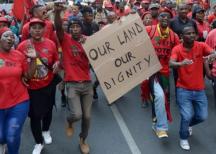
In a fascinating account of the Maasai’s struggle for land rights, Kenyan writer Parselelo Kantai reveals modern ‘development’ taking the form of a US$100 million loan from the World Bank’s private sector lending arm granted to a foreign-owned company exploiting soda ash on traditional Maasai land. When the Maasai demonstrated against the renewal of the illegal leases upon which the loan agreement was based, the Kenyan government violently suppressed the movement. Kenyan independence, he argues, merely led to a 'change of guard', with nationalist elites protecting a profitable post-colonial arrangement rather than addressing the legitimate grievances of one of the country’s poorest ethnic groups.
While Kantai’s account focuses on the complicity of African governments and the World Bank in replicating colonial power structures, Fahamu director Firoze Manji draws attention to how development NGOs have, wittingly or unwittingly, played an integral role in reproducing the unequal social relations of post-colonial Africa. The very existence of the ‘development experts’, he argues, is justified by a discourse framed not in the language of rights and social justice but in a 'vocabulary of charity, technical expertise, neutrality, and a deep paternalism which was at its syntax.'
This inherent inequality between ‘developers’ and ‘developees’ is at the heart of many of the narratives to be found in this anthology. Whether a UN bureaucrat on an inflated salary or an NGO volunteer 'doing their bit' to help Africa, the very existence of this advantaged development set depends on and is justified by the gross inequality that exists between local and foreign elites and the majority poor. By treating poverty as a ‘problem’ to be solved by technical expertise and outside assistance, the donor-driven development process ignores, and even contributes to, the very issues that are at the heart of Africa’s ‘underdevelopment’: the erosion of African peoples’ sovereignty by aid dependency; the perpetuation of post-colonial economic and social relations by corrupt elites; and the negative impact of the donor-prescribed neoliberal policies on African economies.
It is not only the big development players whose failings are scrutinised. Social justice activist Onyango Oloo targets the anti-globalisation antics of the ‘activist elites’ at the World Social Forum. Often seen as the antithesis of donor-driven and top-down development, he claims this 'annual jamboree of navel-gazing, self-referencing civil society global trotters' merely hijacks the ideals, struggles and aspirations of real social movements. In a call echoed by many of the book’s contributors, he challenges self-proclaimed champions of the poor and marginalised to get down from their high horses and do some serious introspecting on their activities. Author and scholar Issa G. Shivji extends this rebuke with his admonition of what he calls the 'silences in NGO discourse'. If African NGOs are to become true catalysts of change, he maintains they must not only re-examine their relationships with donors, but the entire philosophical and political premises that underpin their activities.
Presumably, the main target audience of the book are the very protagonists whose professional raison d'être is being questioned. For anyone actively interested in the plight of Africa’s poor, it has the potential to provoke some serious soul-searching on the value of ‘development’ – not only as an industry, but also as a paradigm for understanding the relationship between the rich and the poor.
While this thought-provoking and often entertaining look at the failure of Africa’s development machine tears apart the romantic illusions upon which the aid industry is based, it does not seek to offer any grand alternatives. There are a few scattered, and in some ways contradictory proposals for the way forward, but these act only to further illustrate the diversity of perspectives that challenge the status quo. Warah’s anthology is not an introduction to a world beyond development, but rather a challenge to begin imagining one.
BROUGHT TO YOU BY PAMBAZUKA NEWS
* Rasna Warah's 'Missionaries, Mercenaries and Misfits: An Anthology' (ISBN: 9781434386038) is published by AuthorHouse.
* This review was originally published by Share The World's Resources.
* Anna White is the editorial assistant at Share The World's Resources. She can be contacted at anna [at"> stwr [dot"> org.
* Please send comments to [email protected] or comment online at Pambazuka News.
- Log in to post comments
- 1648 reads
Author

Anonymous (not verified)