
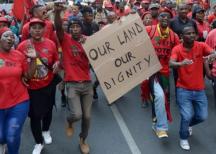














Over four hundred demonstrators were taken into custody after protests were staged in 34 urban centres in Zimbabwe yesterday (13 September). In this paper Maggie Makanza explores why the opposition in Zimbabwe has not been effective. She asks: “Why has the pro-democracy movement not been able to capitalise on the many reported failures of the ZANU (PF) government?” She explains that the reason the people of Zimbabwe have not revolted against the Mugabe regime is because although they agree on the need for change, they are unsure about where the MDC is taking them.
Why has the pro-democracy movement not been able to capitalise on the many reported failures of the ZANU (PF) government? Some people say all the necessary conditions needed for combustion to happen exist in Zimbabwe. All that is needed is a spark.
Most pressure for reform appears to be coming from external rather than internal forces. There have been calls for the international community to intervene and for President Thabo Mbeki to 'do something' about the Zimbabwean crisis. Such efforts as we know have not yielded any results.
If anything, positions have hardened and the situation continues to deteriorate at an alarming rate. There is something special about one who has the ability to laugh at one's situation in spite of its gravity. That person has transcended the boundaries of what others call normal and refuses provocation. Zimbabweans have that 'collective character' that the world has termed the 'great Zimbabwean mystery'. Should you ask them, how are things in Zimbabwe, the response without fail is “Zvakaoma”. Meaning, it is 'tough'. It is an abnormal response for one not to be outraged in the face of extreme provocation. Let’s explore why.
The Change Equation
The change equation tells us that change equals the degree of dissatisfaction with one's current situation, plus a compelling and attractive vision for the future. The assumption has been that if we increase the level of discomfort and suffering of the Zimbabwean people, change will inevitably come. It has not despite the fact that Zimbabweans were rated as the unhappiest lot in the world (survey in June, 2006).
While we as a nation are clearly dissatisfied with our current reality, specifically the economic situation, the forces for democratic change have failed to provide Zimbabweans with a compelling and attractive vision of the future. While people agree on the need for change, they are unsure of where the MDC is taking them.
The end state is not clear. Is it simply about a change of government or more so, a change of rulers? There has been a lack of clarity on the political position of the pro-democracy forces on key and emotive issues like the land reform programme. Discontent alone is not sufficient as a rallying point for change.
On the other hand, the ruling party ZANU (PF) had a potentially compelling and attractive vision of the future given our liberation history and the primary reason why we fought a war(s). Notice that I use the word potential, because it has not been realised. They failed to package their vision of transforming Zimbabwe and did not sufficiently share it with the masses.
The people of Zimbabwe have therefore questioned their motives for propelling the land question forward at this point in time. The poor and chaotic implementation of the Land Reform programme, shrouded in corruption and greed by officers in high places, has made it difficult for people to buy into the ZANU (PF) vision of the future.
Also, it must be noted that while it is an acknowledged fact that those of us in the Diaspora have been disenfranchised by the Mugabe regime, there is a general disengagement by Zimbabweans from active participation in politics. We are usually resigned to being armchair critics. This disengagement is evidenced in the ways external people express themselves in reference to the MDC and ZANU (PF). You hear people saying 'what the MDC should do is………or ZANU (PF) should do A, B and C to get the economy back on track'. These statements are telling. They show a clear distancing of oneself from these two major political parties.
The lack of energy and inertia to fight the regime could partly be explained by what I will term a latent support for the ZANU(PF) programmes and policies, specifically with regards to the Land Reform program and Mugabe's position on imperialism and neo-colonialism. The opposition has worked on the false assumption that no one supports ZANU(PF). This assumption has largely informed the politics of protest by the MDC and other opposition forces, which is naïve for a group fighting for democracy.
According to Machiavelli in his book “The Prince”, when you introduce a new order of things, you face resistance from those who stand to lose from a change in the status quo, and you must know that you have only a few lukewarm supporters of change who might benefit from the new order. There are a lot of people currently benefiting from the status quo. So why change something that you are benefiting from? They are working tirelessly and conspiring with the regime to make change impossible.
Democracy and governance amid poverty
The rural constituency has largely been misunderstood and underestimated. Through the arrogance of the political elite, they have often been used during elections and thereafter abandoned. They have clearly expressed their displeasure at the failed promises by the current regime to deliver. An attempt to show this displeasure was expressed in the many Parliamentary and Presidential elections since independence.
But they learned quickly. They now perceive politicians as an interruption to their serene and daily living. So, through a series of elections they have learned that this process is not beneficial to them in any way as it does not change their lives. The rural electorate have therefore decided to play games. 'Give the urbanites their votes and let them go back to Harare with minimal fuss. We will not see them for another five years'.
Voting is the power to decide. The act of giving somebody the power to decide their future assumes that one indeed has the power within their hands to make their own decision. This assumption is a complete fallacy. In a situation where poverty is rife and ignorance abounds, elections simply become a process whereby those who have access to resources abuse those who do not.
What is needed is radical change to the instruments for operationalising democracy in developing economies. The continued use of the ballot box under the present circumstances can only be described as sheer madness. Why continue to do the same thing when you know that that getting a so-called partial Electoral Commission to preside over the process is impossible? When the nature of humans is that of self-preservation and protection, why should the ruling party level the playing field?
The framework for democracy as currently conceptualised has become the source of much pain and suffering for the people of Zimbabwe. The last elections in Zimbabwe are a clear case in point. As one writer said 'it was a predictable surprise'. The results of the last election in Zimbabwe make a complete mockery of the people of Zimbabwe, but illustrate how as a developing country we have been fooled. Fooled to believe that democracy comes through an election process, that democracy comes through a box - transparent or not.
Humour and Cynicism - A Survival Strategy for Zimbabweans
The internet and the streets of Harare, Bulawayo Gweru, Mutare and the Diaspora abound with jokes and humour about the political scenario in Zimbabwe. It takes a different mindset, of defeating your enemy without fighting, hunger without starving, and diseases without allowing it to kill you. The ordinary people in Zimbabwe are challenging the premise that you have to fight hunger with food, and violence with violence. There is hope - zvichapera - it will end. This too shall come to pass.
And indeed, instead of fighting the regime, risking leg and limb, fighting that which will in time come to pass is by many seen as an exercise in futility. Many have resolved to wait and watch for the end of the regime’s time. 'It will come' you hear them say. Perhaps Zimbabweans are responding to the Mugabe regime in this way because they have weighed up their options and are indeed responding in the best way possible.
The Shona people were the first to capitulate to white rule in the 1890's, having realised that they would not win the war. They surrendered only to rise up decades later when they felt that they were much stronger. It is actually a recommended war strategy, to retreat in the face of a strong opposition. In the face of a strong enemy, you do not commit suicide, but retreat to regroup when the time is right. Perhaps.
Language plays a major role in the way people think. Our thought processes in turn influence the way we approach problems and find solutions to problems, and subsequently the way we behave. The humour used by most Zimbabweans is a way of playing with words and language to interpret the current events. In a way, the humour has developed into a second language for Zimbabweans, allowing them to talk about the painful situation without actually talking about it.
Often, the humour trivialises the issue and distances it from the person. In most cases, the humour is intellectual, creatively playing with words and abstracts from the current reality. Trivialised, reality therefore loses its power to demoralise and dehumanise its victim.
Towards collective responsibility and the building of a culture of tolerance and valuing diversity
I have often asked this question and risked losing life and limb. I know I am treading on a hornet's nest and risk assault. But I will pose the question anyway. Is Mugabe the real problem or the only problem in Zimbabwe? If Mugabe goes, will that solve our real problem?
I think Mavhaire was the first to make the 'Mugabe must go' call. If Mugabe goes, it will certainly solve the immediate economic isolation and bring back the IMF and World Bank, facilitate economic recovery and improved international relations. It will not however solve our fundamental problems as the people of Zimbabwe.
There is a culture of lack of tolerance for divergent views at all levels of society. I know of family disputes that have gone on for generations because they could not agree on certain issues or 'vakapumhana uroyi'. I know of churches that have split because the leadership did not agree on certain areas. Political parties have split because they could not tolerate different views or agree on the way forward. In the private sector, you hear very similar stories of 'camps' in the organisation. Perhaps it is the way we deal with conflict as a people.
The culture of intolerance is a big problem in Zimbabwe, as well as the lack of unity of purpose in each and every one of us. Selfishness and individualism has ruined us. There is need for us to look at ourselves in the mirror and admit that Mugabe is not the only problem in Zimbabwe. That in our own ways, we have individually and collectively contributed to the situation that we find ourselves in.
What roles can the Zimbabweans in the Diaspora play?
So, do Zimbabweans in the Diaspora have a role to play? Frankly I do not think we can play any significant role in the politics in Zimbabwe from the comfort of our adopted countries or cyberspace.
Yes, we can continue to play the role of breadwinners providing for those relatives who remain in Zimbabwe. There is no way that people can survive on the salaries that they are taking home in Zimbabwe. So how are Zimbabweans coping with the prices of goods and services, which are in no way linked to the pay cheques that people take home? The Diaspora has been sustaining and fuelling these price hikes. The Diaspora has significantly contributed to price and income distortions in Zimbabwe. The breadwinner role of the people in the Diaspora has only served to delay the process of change as it ameliorates and smothers the suffering and creates the false impression that local people are coping. That, unfortunately, is the law of unintended consequences.
Conclusion
The Zimbabwean crisis is like a big party where the invited guests come to the table and the hosts are nowhere to be seen. My call to all Zimbabweans both at home and in the Diaspora, is to come to the 'party'. Stand up and be counted. Whether you are an MDC or ZANU (PF) or whatever political persuasion you are, please show up otherwise this democracy game will remain a concept.
• This is an edited version of a paper presented at the Public Discussion forum hosted by the Zimbabwe Social Forum. Maggie Makanza is a member of the Zimbabwe Social Forum, a psychologist by training. She can be contacted at: [email][email protected]
• Please send comments to [email protected] or comment online at www.pambazuka.org
- Log in to post comments
- 2535 reads
Author

Anonymous (not verified)