

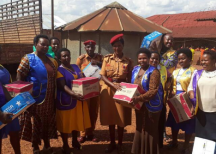










Africa continues to be misrepresented as a continent of victims of poverty, violence and ridden with HIV/AIDS. Selome Araya says campaigns such as "Save Darfur", the Red Campaign by GAP and the "I Am An African" AIDS campaign all contribute to the stereotyping of the continent as a place of despair.
Ask anyone what they think of “Africa” and you may receive a response related to poverty, AIDS, hunger, ‘tribalism’ or animals. Trails of pity might linger in their words as a hint of disgust shimmers in their eyes. They may give an example of how they helped to “Save Darfur” or dreamed of adopting an “African orphan”. Most likely the view of the continent is that it is not a continent at all, but one large country, where everyone speaks the same language, eats the same food, wears the same type of clothing, and creates the same type of art. Yes, in their eyes, “Africa” is a homogeneous place of simple people with simple activities.
But, for someone who has never been to the continent, can they be blamed for this ignorance? The media and “humanitarian” agencies do an incredible job of misrepresenting the birth of civilization and projecting it as a down-trodden place of mishaps and has-beens. A place of disease, poverty, and chaos, and a place devoid of any history or future. Even today, it is still depicted as “The Dark Continent”, with dark tales of gore and war. And it’s not just the media. So-called “experts”, practitioners, and scholars perpetuate these stereotypes to no end, continually feeding the misrepresentation engine.
This cynicism is not to be taken lightly. “Africa” has been placed at the bottom of every pole on the international scale. It is deemed as possibly one of the worst regions on earth, and this notion is perpetuated continually with images and language, misinformation and racism, and media blitz and negative attention. Very few media outlets provide their viewers and readers with positive information about the plethora of countries and events occurring on the continent. For that would be mundane and not “sexy”. Yes, it seems that “Africa” is sexy these days. A crisis in “Africa” gets more response, more money, and more attention than a positive occurrence.
Granted, there are many issues affecting numerous countries in Africa. But I’m appalled at the fact that every time I hear of this place my family and ancestors call home, it is in a negative light, in a pitiful light, in a savagery light, in a deadly light. What I fail to understand is how all other elements of life are negated for the sake of a “good story” and a dramatic plea for funds. I have seen with my own eyes many elements of life that are beautiful beyond explanation, and I beg someone to explain to me why these elements aren’t projected.
Recently I was skimming Elle Magazine (yes, clearly not a place to be reporting on affairs of an international nature) and was deeply disturbed by the only two pages dedicated to “Africa”. The article disturbed me so much that I had to write a letter to the Editor expressing my utter disgust at their depiction. Africa was [mis] represented as a place where everyone is dying, has AIDS, or who is thirsty and hungry. There was no context provided, nor was there any balance that spoke of the positive elements of the continent. There was no mention of how people are responding to their own needs. All that was discussed were ways in which Europeans are “saving” this dreadful place from falling further into its cave of darkness. I couldn’t help but wonder how many readers of this pretentious high-fashion magazine walked away with a haunting perception of a place that they have never been to. If I were reading about “Africa” for the first time, I surely would think of it as a place that is just a hot mess of hell.
As a graduate student at Columbia University, where so-called “experts” teach aspiring public health students about “Africa”, I experience the same generalizations and stereotypes being perpetuated. These “experts” have dedicated their lives to joining the “saviour” movement that’s happening in certain circles of humanitarian assistance. And so, “women” are all victims and need outsiders to help them do everything. “Child soldiers” need to be rehabilitated by people from European countries. “Women and children” need outsiders to intervene and “save” them from the heathens that are the men in their lives. Everyone is dying of some disease. Every home seems to be in a dilapidated state with no food, water, or electricity. Almost everybody is in need of a program designed from abroad. People don’t know (or remember how) to grow their own food, so they need continual food aid packets dropped in their “communities”. And everyone belongs to a “culture” and has traditional ways that they live their lives, in their villages.
“Health” must be shaped from a Western point of view. It sickens me to hear how excited they become as they talk about the next country they are travelling to, to implement their pre-designed projects on people. They are the Lords of Poverty and aren’t even conscious of the stereotypes they carry with them as they lecture. And they’re producing an entire pedigree. Many of the students make drastic generalizations and proclamations about the countries they have lived in (for three months) and become self-proclaimed spokespersons for this region of the world.
There are also many campaigns today that continue to project negative perceptions of Africa onto the world. For people who have no exposure, direct contact, or knowledge of Africa, these campaigns are down right dangerous and counter-productive. Instead of “raising awareness” about important causes, they invoke pity for “the other” and perpetuate the concept that Africa is backwards and in need of saving. The campaigns I am referring to are the “I am African” campaign, the “Red” campaign from The Gap clothing company, and the numerous “Save Darfur” campaigns occurring in the world. As I walked down the streets of Manhattan today, I retained some of the advertisement for the “Red” campaign at the Gap. It pleads for people to help end AIDS in Africa and to save women and children from dying. Again, another universal representation of Africa for all of the Gap Corporation consumers. The millions of Gap Corporation consumers.
The “I am African” campaign is one that may have good intentions, but is grossly offensive and appalling. Appalling because an African woman is behind it, offensive because of the feathers, face paint, and European superstars posing as “Africans”. So now we have Gwyneth Paltrow with striped paint on her cheek, a plethora of jewellery on her neck, with the phrase “I am African” across her chest. I understand the point is to educate people on the AIDS crisis on the continent, but could it not have been done in a more respectful, tactful, and tasteful manner? But more importantly, what these campaigns do is make “AIDS in Africa” a commodity, something that is fashionable and marketable, and makes the only reference people have to the continent one that is linked to death and poor health. To have celebrities (who are not of African descent) say that they are “African” is to imply that since they are now “African” they also somehow have AIDS. It’s sending a message that being African is synonymous with AIDS.
International Non-Governmental Organizations who do business in “Africa” are no better. They spend much of their time and resources depicting the continent as a place that only they can “fix”, and spew out endless facts to justify their own causes. Yes, they are there to save the lowly Africans, and the more dramatic the picture or story, the more support they receive. And more importantly, the longer they stay in business. What people fail to understand is that, while it is imperative to raise awareness about the global poverty that is the reality for billions of people around the world, it is not helpful in the least to project an entire continent through a one-dimensional lens that is lined with despair and imbalance.
If people are going to campaign and discuss such despair, they need to provide context and background information, and underlying root causes of issues like AIDS and other poverty-related concerns. To simply present them independent of any other information is to represent people as helpless, hopeless victims who need saving. It is time for a change. It is time for “Africa” to be uplifted more often in the media. We need to hear more about the other dimensions of life for “Africans”; those that are not living in abject poverty and dying every second from whichever health concern is “hot” at the moment.
There’s music, there’s movement, there’s knowledge, there’s progress, there’s love, there’s tradition, there’s strength, there’s beauty, there’s nature, there’s power, there’s wealth, there’s health, there’s humanity, there’s history, there’s unity, there’s peace, there‘s LIFE. Sometimes, wouldn’t it be great to hear about these elements too? Because the “Africa” that I know is much more than death.
* Selome Araya is a community activist and freelance writer who is currently finishing her Master's degree in Forced Migration and Health.
* Please send comments to or comment online at www.pambazuka.org
- Log in to post comments
- 16562 reads
Author

Anonymous (not verified)