



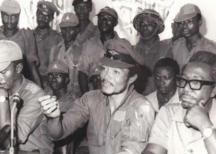








http://www.pambazuka.org/images/articles/324/43776-Sankara.jpgKoni Benson and Mukoma Wa Ngugi interview Aziz Fall, Co-ordinator of the International Campaign for Justice for Sankara (ICJS) on the 20th anniversary of the assassination of Thomas Sankara.
President Thomas Sankara, affectionately referred to as Africa’s Che Guevera was assassinated in Burkina Faso on October 15th, 1987. Twenty years later, his assassins remain in power and continue to reverse the revolutionary changes Sankara initiated.
We interviewed Aziz Fall, the co-ordinator of the International Justice Campaign for Sankara (ICJS) who has been receiving ongoing anonymous death threats since December 2006. He has been co-ordinating 22 lawyers from France, to Senegal, Canada, Togo and beyond, dedicated to using legal means to find the truth behind Sankara’s assassination.
We started the interview by asking Aziz Fall about the death threats against him and his family, and about ICJS and the UN judgements on Sankara’s assassination. We then asked him about some of Sankara’s achievements in relation to the emancipation of women, education, and neo-colonialism in the 1980s, and then moved onto questions about power, politics, and policies in Burkina Faso under President Blaise Compaoré who has been in power since Sankara's assassination in 1987. Lastly, the interview reflects on Sankara’s legacy and his continuing relevance in this age of globalisation.
Aziz, Can you please tell us the nature of the death threats? What do they say? Do have an idea of where they are coming from? Are they from the government? Third parties? Is it one person or several people etc?
Thank you. I’ve received four death threats since December 2006. Three letters in bubble envelopes left in the mailbox at my front door. The first one was simple and said “stop or be stopped,” the second was similar but didn’t mention my name, and the third was a little more explicit, mentioning my name, asking me “to commit suicide or face execution.” I filed a complaint with the police in March 2007.
Then, in April, after the screening of a film on Thomas Sankara in Montreal, a young Burkinabé journalist, Sam Kah, who appeared in the film, received a threat, according to the organising committee of the Thomas Sankara 20th anniversary commemorations. The committee had invited both of us to their activities which take place Oct 11-15th, 2007. Following the threat against Sam Kah, I decided to tell the committee members about my own death threats, which I had previously hidden from them because I was worried it would have a demobilising effect.
They issued a press release concerning the threats against the two of us. A couple of days later, I received another threat, this time by phone. A man with a strange accent warned me that neither the police nor my lawyers would be able to protect me, and that since I still didn’t understand, my family would be targeted first, then me.
At about this time, someone tried, unsuccessfully, to break into my home through the back door. This was discovered as we were installing an alarm system.
We don't know exactly who is behind these threats. But we have good evidence that a Frenchman and two Africans have something to hide, because they have been caught in a number of lies and contradictions. The police and CSIS, Canada’s spy agency, are still investigating. That’s all I can say at this point.
It is unacceptable that as an advocate of freedom and justice, I am being physically threatened in a country that promotes these basic values around the world. We have approached the Canadian authorities about this situation, and we have great hope that they will do everything to solve the matter.
Can you briefly talk about the International Campaign Justice for Sankara (ICJS) and GRILA? How does the United Nations judgement (in which the Committee considers that the refusal to conduct an investigation into the death of Thomas Sankara, the lack of official recognition of his place of burial and the failure to correct the death certificate constitute inhuman treatment of Ms.Sankara and her sons, in breach of article 7 of the Covenant) affect the search for justice on behalf of Sankara?
Sankara's widow, Mariam Sankara, and his two sons never abandoned their call to the international community to take action to bring his assassins to justice. Ten years ago, the Group for Research and Initiative for the Liberation of Africa (GRILA, an internationalist and panafricanist group) answered that call by creating an international campaign with a twofold strategy involving a political component and a legal one. I had the honour of co-ordinating a team of 22 lawyers, which put together a case for a full investigation into the murder of President Sankara and a dozen of his colleagues.
The government of Burkina Faso, under the presidency of Blaise Compaoré, along with a highly compromised judicial system, blocked all efforts by the Campaign to bring the case to court. After exhausting all possible legal recourse within the country, the Campaign brought the case before United Nations Human Rights Committee. Just over one year ago, the UN Human Rights Committee ruled in favour of the International Justice for Sankara Campaign, and demanded that the government of Burkina Faso take action to shed light on the circumstances of Sankara's death.
(See )
That was actually a world first, and certainly a legal precedent in Africa, creating a breach in the cycles of impunity that characterize the political life of our continent. There is also a link between the Sankara case and the trial of Charles Taylor, the former Liberian head of state, who plotted with Compaoré in the assassination of Sankara. We expect the final UN judgement to be announced later this year and really hope that it will represent a major step forward in the global struggle against impunity.
What were some of Sankara's achievements, be it in the emancipation of women, education or rolling back neo-colonialism?
Our organisation (GRILA) and the revolution in Burkina Faso are the exact same age and we have many things in common. So we may sound pretty subjective when it comes to our assessment of what was achieved in those three years. Sankara tried to put into practice most of the key elements of our own philosophy; among other things, the destruction of all forms of racism and ethnocentrism, with the Bambaata summit and the anti-apartheid struggle; the respect of collective and human rights; the struggle against regimes allied with imperialist interests; a balance between rural and urban incomes; food self-sufficiency; the fulfilment of basic needs. A key issue for Sankara was the political, economic and social emancipation of women and the transformation of sexist mentalities. That particular aspect was crucial in a very traditional society where sexism was so with entrenched. Men were invited to go to the market once a week, women were appointed to key State positions, and civic rights and the constitution granted women important advantages.
While there were mistakes and contradictions due to the weakness of his alliances, Sankara was steadfast in focusing on other key issues as well, issues that are still cornerstones to our own work, namely, popular and civic participation, popular democracy and the promotion and empowerment of Africa's youth. Sankara promoted self-reliant, ecologically sustainable development, and invited locals and foreigners alike to plant trees; the emergence of regional panafricanist states that were politically and economically accountable to their citizens, as evidenced by his attempts to unite with Ghana. Sankara was committed to fighting corruption, and personally served as a very modest example, refusing to live a life of luxury and reigning in any tendencies by those within his government toward ostentatious consumption.
Are some of these changes still visible or has the Compaoré government managed to erase all of them?
While the Sankarist regime laid the ground for stability and a better form of development, it is clear that the international order ensured that Compaoré's regime did not take the same path. Compaoré’s regime was also involved in the Liberian and Sierra Leonean crises and wars, generating tremendous wealth for itself. The government has become very wealthy, which has allowed it to bribe some of the opposition elite, while intimidating or killing others. Within the framework of the neo-liberal agenda and the French zone of influence among its former African colonies, the regime has been able to establish a formal democracy and to reproduced itself, and in so doing has widened the gap between the haves and the have nots.
Compaoré has recently amended the constitution so that he can run for a third term which means he will have been in power from 1987 to 2012.
A very common phenomenon in Africa indeed. It's a pity, but history will judge. Killing your comrades and opponents and tailoring the constitution to fit your needs is nothing new. Even if the population is frightened, and busy surviving the harsh conditions of unequal development, there is no doubt that one day it will rise up against this.
How do the people of Burkina Faso regard Sankara today? Is he still part of the political imagination?
In general, people have a lot of admiration for him despite of the regime’s anti-Sankara propaganda and intimidation. The teenage generation doesn't know him well, and many may just know him as an icon. However, it is heartening that at the African social forum in Bamako, Sankara was chosen as a leading model. As my comrade Ameth Lô wrote, “The Sankarist alternative remains, therefore, entirely relevant in addressing issues surrounding development and lasting sovereignty. It is a panafricanist socialist alternative, focused uniquely on meeting the needs of the African masses, impoverished by decades of structural adjustment programs that had no results other than to ensure continued payments to shameless creditors for the so-called debt that's not only immoral—since a third of the initial debt has been repaid—but also because the borrowed funds were never injected into the economic and social fabric of these countries.” (see http://www.grila.org/e_forum.htm)
We'll see how the population will react on October 15, but it is clear that Sankara is going to be celebrated in many countries this year, which has been named Sankara Year by his supporters. That is surely a great sign of vitality and political imagination!
How does Sankara challenge the idea of revolution today? What is his legacy? What is his continuing relevance in this age of globalisation?
I think that GRILA is living proof of that legacy, and that the struggle that is at stake, in this process of so-called African union and various attempts at integration, has to consider what we are still advocating, namely: democracy and progressive strategies that focus on self-reliant and popular development. Africa should rely more on its own forces, within a socialist and panafricanist perspective, and develop strong ties with other third world countries. This form of development entails subordinating external demands to internal needs. A consciousness that is increasingly homogenised by the dominant values of today's globalized world system, however, is incapable of envisaging such a path. As the Burkinabé revolution was trying to achieve, GRILA's task as well as that of any other progressive political force in Africa, should be to contribute to re-politicizing the discussion around development, fostering a new political consciousness, and channelling the efforts of an organic intelligentsia that will be capable of building an alternative to the disorder now ravaging Africa.
How are these challenges being addressed today—locally and internationally?
For us it is important to continue the work. We will not be intimidated. Locally the Sankarist movement, despite numerous factions, is more united and better organized. In many African countries and in the Diaspora, Sankarist clubs and associations are mushrooming. A lot of people expect that history will repeat itself in a cyclical fashion. But each society is confronted with new challenges, and will take different roads. It appears to me that as long as the contradictions of capitalism deepen, and societies continued to be destroyed by the capitalist way of life and production, we have no choice but to invent more progressive and internationalist paths in order to tackle the barbarism of globalisation and the forces that dominate it.
* Koni Benson is a researcher at the International Labour Research and Information Group in Cape Town.
* Mukoma Wa Ngugi is the author of Hurling Words at Consciousness (AWP, 2006) Conversing with Africa: Politics of Change (KPH, 2003), and editor of the forthcoming, New Kenyan Fiction (Ishmael Reed Publications, 2008). He is a political columnist for the BBC Focus on Africa Magazine.
* Please send comments to [email protected] or comment online at www.pambazuka.org
- Log in to post comments
- 2892 reads
Author

Anonymous (not verified)