
















In a potent challenge to the Bush administration’s stated aim of increasing security on the African continent, Nunu Kidane argues the US’ sudden interest in the military AfriCOM initiative to reflect both unease over future control of natural resources and the increasing Chinese presence in Africa. As a means of actively opposing the initiative’s progress, the author urges readers to participate in the Resist AfriCOM campaign to say a clear and unequivocal ‘no’ to Washington’s AfriCOM programme.
For years, the US never considered Africa as a priority foreign policy agenda. The only context in which Africa came up in Washington was for preferential trade as in AGOA (Africa Growth and Opportunity Act) or in AIDS-funding from PEPFAR and of course humanitarian assistance. Despite its continued use of the term ‘partnership with Africa’, no administration viewed Africa as anything but a source of extractive resources and a perpetual conflict ridden region with few business opportunities.
So now, when the US declares Africa to be a very important region and pays special attention to it, one has got to be suspicious. With little fanfare, on 1 October the US officially launched a new militarised initiative for Africa that has come to be known as AfriCOM, or the Africa Command. The announcement was held in a small press conference at the Pentagon where Defense Secretary Robert Gates stated: ‘AfriCOM represents yet another important step in modernizing our defense arrangements in light of 21st century realities.’
According to William (Kip) Ward, the African-American General who will be heading the command, AfriCOM is about ensuring security and interventions to prevent war and conflicts. He admits the increased need for an Africa Command came in the post 9/11 ‘global war on terror’, where Africa is seen largely as ‘ungoverned’ states where extremists are posing a threat to US national security. A special case that is frequently used to depict these ‘lawless’ states is Somalia. The southern region of Somalia has remained in internal conflict since the last president was deposed in 1991. When finally an indigenous civil society group reinstated order and stability, the US (and its ally Ethiopia) declared them ‘Islamic extremists.’ In January 2007, the US bombed innocent Somali civilians - an act which went unreported and un-criticised - and continues to use its military interventions either directly on the country or through its alliance with Ethiopia.
With the prerogative of openly using military power against states that ‘threaten the US national security’ AfriCOM will operate with little supervision from Congress or international bodies like the United Nations. Prior to the announcement of AfriCOM, Africa was treated as a side region and US military command was divided between the European, Pacific & Central Commands. In fact, the headquarters of the newly launched AfriCOM is still based in Stuttgart, Germany, but will not be so for long. When fully operational, the new Africa Command will not only be based in the continent, but will ‘network’ and militarise all aspects of US policy with Africa.
If you're thinking traditional bases with thousands of military personnel, think again. General Kip Ward has said it is not about ‘bases’ and ‘garrisons’ but rather a network of sophisticated military operations strategically placed throughout the continent which can be moved around and utilised for any purpose. General Gates called AfriCOM ‘a different kind of command with different orientation, one that we hope and expect will institutionalize a lasting security relationship with Africa.’ It is ‘a civilian-military partnership’ where diplomatic and humanitarian relief by the US Agency for International Development (USAID) will get directives from the Department of Defense. Imagine US military personnel delivering emergency aid and conducting diplomatic missions and the appropriate term is ‘colonisation.’
AfriCOM is being sold to the public as a good thing for Africa, one that will bring lasting peace and stability to a continent rife with conflicts and disasters. Many African heads of states are not buying this and have rejected the move including the most powerful 14 state-member Southern Africa Development Community (SADC), which publicly denounced AfriCOM. Typical of past US historic missions in Africa, there was no prior consultation with African leaders and many heard about it when it was officially announced on 6 February 2007. The Department of Defense sent medium-level delegates to ‘sell AfriCOM’ to heads of state after it had been finalised, but African leaders rejected it as a threat to their sovereignty and a move to further militarise Africa; the last thing Africa needs is more militarisation! . The only exception is, ironically, the first and only democratically-elected female president in Africa, Liberian President Ellen Johnson-Sirleaf. When heavily criticised about her support from AfriCOM, Johnson-Sirleaf admitted it is an unpopular move but one she has had to take to secure high infusion of US capital for her country’s beleaguered economy.
Why is the US suddenly interested in ‘prioritising’ Africa? The answer is the same one that has motivated countless interventions into the continent in the past centuries: control of resources. The need for the US to secure oil from the Niger Delta where it is estimated by 2020, a quarter of the imports will originate. Equally important are ‘strategic minerals’ which the US has substantial dependency on. Without cobalt, manganese, chromium and platinum, among others, most US technological and military industries would come to a halt.
Another perceived threat and rationale for AfriCOM is China's increasing presence in Africa. It is not ‘new’ as it may seem to be, China has been building industries and accessing oil and extracting minerals for at least decades. Despite the growing criticism on China for its military and industry activities in Africa, many say it at least provides African countries with an alternative to the dominant Western capital push which had remained challenged until recently.
Excluding Egypt, AfriCOM will when fully operational in effect have a sophisticated and well-networked military capability throughout 53 African countries. The Department of Defense will oversee ‘civilian’ activities that were previously the mandate of diplomatic and humanitarian agencies. We can also count the increase in private military activities which, as seen in Iraq, remain unregulated and with no congressional monitoring.
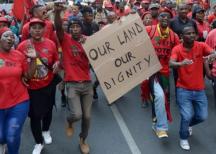
This fundamental shift in US-Africa relations has come under tremendous attack by civil society and policy research groups in both the US and Africa. A national coalition group has organised as a way to counter the move; Resist AfriCOM is conducting massive education and mobilisation to send a clear message to Washington in solidarity with African civil society to say a clear and unequivocal ‘no’ to AfriCOM (visit http://www.resistafricom.org)
How does one say no to a policy that was announced a year ago and has been, for all intents and purposes, officially operationalised already? Through continued response from the grassroots in the US (working in partnership with African civil society), the progressive Africa-justice community and the peace movement in the US has a responsibility to continue to reject this initiative even when it appears to be moving ahead.
As a good friend from the anti-apartheid movement always states, the US had officially sanctioned and supported the racist apartheid state of South Africa politically and economically. To those who were working actively to oppose it at the time, it seemed like an impossible task to change these policies and indeed it took decades to do so. But logic and morality prevailed and eventually, through national grassroots pressures, the US made radical shifts to its policy and denounced apartheid.
AfriCOM is nothing new, it is simply a new initiative to ensure ‘command’ of land and resources that in the past was called just plain ‘colonialism.’ As the competition for global resources tightens, not only for oil and minerals, but for basic rights to land and water, we can expect increased focus on Africa as the new frontier. Joining this increasing Africa resistance movement and speaking out against Africa Command is should be everyone's responsibility.
* Nunu Kidane is network coordinator for Priority Africa Network, based in Oakland, California.
* Please send comments to [email protected] or comment online at http://www.pambazuka.org/
- Log in to post comments
- 1186 reads
Author

Anonymous (not verified)