













 cc Economic sanctions against Zimbabwe are worsening the plight of ordinary citizens in an already harsh climate and should be lifted immediately, urges an ‘Appeal for Zimbabwe’ launched in Mali in February. Signatories to the petition declared that drinkable water, food and medicine must ‘cease to be deployed as weapons of war’, and reminded the UK, the US and the EU ‘of the exorbitant social and human cost of the punitive measures’ they have used in a bid to drive regime change in Zimbabwe. Zimbabwe is grappling with 94 per cent unemployment, the highest inflation rates in the world and food shortages affecting an estimated seven million people.
The more than 3,000 deaths and nearly 70,000 people affected by cholera in Zimbabwe, with risks of the epidemic spreading to neighbouring countries, have not been enough to end the economic sanctions Great Britain and its allies have imposed on this country since the end of the 1990s. That’s how the European Council, during its session on 26 January 2009, decided ‘to extend for another year the Common Position on restrictive measures against Zimbabwe’. Of extreme gravity, such a decision can only exacerbate a situation that is already characterised by the highest unemployment (94 per cent) and inflation rates in the world, by food shortages that seven million people suffer from, by a lack of schooling for children, as well as brain drain and labour outflow, which includes many teachers and medical staff members.
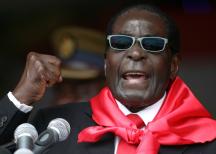
The sole wrongdoing of a Zimbabwean people deprived of jobs, income, drinkable water, healthcare and of food – all in all condemned to a veritable descent into hell – is being led by Robert Mugabe, whose ousting and overthrow have been demanded during long weeks of destabilisation and demonisation. The former colonial power, political opponents of the Zimbabwean president, NGOs and mainstream media all accuse him of having ruined the country, of violating the rights of his fellow citizens and of remaining in power through the repression of his opponents, electoral fraud and ballot rigging. With Mugabe having refused to resign, the power-sharing deal with his main rival Morgan Tsvangirai has just been concluded after four months of talks, talks during which the president of the Movement for Democratic Change (MDC) acquired, on top of the position of prime minister, the control of key ministries.
It’s a good thing that the Southern African Development Community (SADC) member countries’ meeting held on 30 January 2009 led to this peaceful outcome, an outcome which has just translated into the setting up of a government of national unity. Let’s hope that President Robert Mugabe and Zanu PF (Zimbabwe African National Union – Patriotic Front) will live up to expectations and this crisis will only be a bad memory!
But this important step is only the start of a normalisation process. To end the agony of the Zimbabwean people, what’s required is the immediate and unconditional lifting of the economic sanctions that have widely contributed to throw former Southern Rhodesia into such a calamitous situation.
Such a reading of the Zimbabwean tragedy from the point of view of punitive measures that kill, starve and impoverish innocent people does not exempt or exonerate the Zimbabwean president and his party for the mistakes they may have made at all. It is a matter of giving a chance to peace by highlighting fundamental facts which have deliberately been overshadowed and concealed.
Let’s go back to the Lancaster House Agreement, which in 1979 ended 14 years of fierce struggle for the liberation of former Southern Rhodesia from the
claws of the racist Ian Smith. It was signed in a context in which 6,000 white farmers owned more than 15.5 million of the country’s most fertile hectares. Meanwhile, with difficulty, nearly 4.5 million blacks lived on community land, often arid, where settlers had confined them during one century. The willing buyer, willing seller principle is one of the main aspects of the plan of action which was supposed to remedy that situation. Ten years later, it had not evolved in a tangible way because white farmers increased prices and were only giving up the less fertile land.
In 1997, Tony Blair’s government made it known to Harare that it could no longer financially contribute, as agreed, to the transfer of farmland to blacks by compensating British farmers who were supposed to be expropriated. The Zimbabwean president decided then to confiscate their land without compensation. Economic sanctions are the financial, economic, social and political war machine that has been deployed by way of punishment meted out by Great Britain and its allies, particularly the United States. Let’s judge for ourselves:
- In December 2001, the United States Congress passed the Zimbabwe Democracy and Economic Recovery Act. It comprises, among other things, the US opposition to any loan to Zimbabwe and to the cancellation of the debt by international financial institutions. This act has widely contributed to throw Zimbabwe into economic recession and turmoil and visit upon it a more and more vertiginous and astronomical inflation rate.
- In 2002, the Bush administration also implemented a programme entitled Governance & Democracy with a budget of US$6 million to support opponents (MDC, trade unions, religious groups, ‘independent’ media, etc…).
- At the peak of the land redistribution campaign, the United States opposed the World Food Programme (WPF) aid to Zimbabweans.
- In 2004, the Bush administration also opposed the support of the Global Fund to Fight AIDS to help sick people in Zimbabwe.
- Since 2002, the United States and Great Britain have been urging the European Union to impose sanctions on Zimbabwe, which is in violation of article 98 of the Cotonou Agreement signed in 2000 between the European Union and the ACP (African, Caribbean and Pacific) countries.
- All the funds granted by several Western countries and devoted to education, healthcare and sanitation were suspended.
Let’s add to these sanctions the usual and disastrous consequences of the Structural Adjustment Programmes (SAPs) from the International Monetary Fund (IMF) and the World Bank – namely liberalisation, privatisations, low wages, and worsening living conditions – as well as the more frequent cycle of droughts to understand the deep underlying causes of Zimbabwe’s sorry plight. Other African countries escape this fate only because they live with cash injections from external funding, funding of which this country is deprived.
Sanctions imposed on Zimbabwe are even more unjustifiable when they proceed from states or institutions that are non-transparent and non-democratic in their dealings with Africa if we study the rules of global trade, the terms of economic partnership (EPA) or African migrants’ re-admission agreements. They are illegitimate because they are unrepresentative of the African people whose rights they deny and trample underfoot but to which they callously pay lip service in their defence of their own interests.
Such undemocratic and murderous economic sanctions also stem from political and financial corruption insofar as by punishing leaders they consider undesirable, world powers dissuade other leaders who would otherwise be tempted to stray from the straight and narrow.
Democracy, human rights and good governance are debased, instrumentalised and discredited when powers who claim to be their representatives ridicule them or even convert them into dreadful weapons of pressure, domination and blackmail to withdraw their financing.
It’s high time to prioritise in the discussion on the present and the future of the post-colonial state in Africa, the key question, which is often overshadowed and concealed, of the control of resources as well as the initiative of change, including agrarian reform. Beyond the extreme personalisation of the political debate, Robert Mugabe’s country is, in this regard, a textbook case to meditate on at a time when you see multinationals from all over the world rushing to grab the fertile land of the continent and everything being sold off in the name of growth and the prevailing whims and supremacy of the market.
While the diagnosis is biased and the economic sanctions are deadly for entire populations, voices exhort President Obama to pursue the same course. In his turn, his ‘Yes we can’ does require a radical change in perspective, discourse and practices in terms of US foreign policy in Africa. It is of the utmost importance that he plays on the black continent, as in the Middle East, the listening and outstretched-hand card instead of carrying on with sanctions that are one way or the other nothing but a violent onslaught against destitute, helpless and uninformed people.
More practically, it means discarding and jettisoning George W. Bush’s ‘axis of evil’ theory, a theory which has inflicted on the world the aggression against and occupation of Saddam Hussain’s Iraq and the barbaric and repeated attacks of Israel against the Palestinian people, illustrated with the latest deluge of fire power unleashed on the Gaza Strip. In Africa, this theory applies to a certain extent to Zimbabwe too. The clarification of global economic, social, financial and environmental issues, in order for Zimbabweans and, more generally, Africans to be committed to the democratic process on grounds other than the mere alternation of power for its own sake and the jockeying for key positions, is the real challenge which should preoccupy and be uppermost in the minds and thinking of African leaders, sub-regional institutions as well as the African Union and the genuine allies of the continent.
It is perilous for Africa to follow the advice of the masters of this world who have sunk into the mire of a deep crisis, a crisis which serves as a potent indictment of the failure of their model of society that the moralisation of the financial sphere will neither rehabilitate nor manage to restore faith in. As for the legitimacy of political power in Africa, it is necessary to underscore that, beyond the requisite elections, it lies above all in the willingness and ability of elected leaders to trade and manage the resources of the continent in the best interests of those men and women who have elected them and mandated them to do so.
Also, the temporary lull and respite that has been attained by the SADC needs to be used to set up a lasting peace for Zimbabweans and be grasped as an opportunity for the whole of Africa to shed a different light on crises, since its customarily battered image has been considerably tarnished by the hypocrisy of lies which prevail in the analysis of the predicament of this country.
Intellectuals and other actors of critical civil society, along with African and non-African leaders who firmly believe that the black continent is not an isolated planet but well and truly the cradle and birthplace of humankind and an innocent victim of a wild, rampaging and destructive capitalism, need to analyse, reveal and dismantle the cogs of its oppressive machinery.
To give a chance to authentic and lasting peace in Zimbabwe, we join our voices to the chorus of Zimbabweans, the SADC and the African Union. We remind Great Britain, the US and the EU of the exorbitant social and human cost of the punitive measures imposed and foisted upon this country.
- We declare that drinkable water, food and medicine must cease to be deployed as weapons of war.
- We call for the immediate lifting and removal of the blockade that deprives millions of Zimbabweans of these amenities which are absolutely essential for human existence.
- We hold that it is profoundly unjust and irresponsible to make human lives depend on a top-level political power-sharing agreement.
Yes, we can! What is required is to stop mixing up British, US and European interests with the legitimate rights and entitlement of the Zimbabwean and African populations to land, food, drinkable water, healthcare, education, employment and income. WE ARE ALL ZIMBABWEANS!
Signatories:
Aminata D Traoré (essayist, Mali), Jean Ziegler (sociologist, Switzerland), Boris Boubacar Diop (writer, Senegal), Mireille Frantz Fanon (Frantz Fanon Foundation), Diadié Y. Dagnoko (teacher, Mali), Demba Moussa Dembélé (economist, Senegal), Assetou Founé Samaké (biologist, Mali), Bruno Rebelle - Souleymane Koly (choreographer, Côte d’Ivoire), Hamidou Magassa (writer, Mali), Christian Koné (journalist, Burkina Faso), Ismaël Diabaté (painter, Mali), Bibi Diawara (demographer, Mali), Lucette and Christian Morillon (France), Mamadou Goïta (socio-economist, Mali), Sarah Jane Mellor (translator France/UK), Moussa Bolly (journalist, Mali), Valerie Ngo Biem (Cameroon), Jean Michel Naud (teacher, France), Clariste Soh Moube (Cameroon), Moustapha Diaté (economist, Senegal), Aziz Coulibaly (accountant, Côte d'Ivoire), Aboubakary Gollock (economist, Canada), Amadou Gollock (consultant, Mali), Koulsy Lamko (ecrivain, activiste culturel, Tchad/Mexique), Amadou Kane Sy (Kan-si), (artiste plasticien, Sénégal), Juan Montero Gómez (Las Palmas, Iles Canaries, España), Aboubacar Demba Cissokho (journaliste, Sénégal), Oumar Dembélé (professeur d'enseignement secondaire, Mali), ZohraBouchentouf-Siagh (professeur de literature, l'Université de Vienne (Autriche), Algérie), MabroukaGasmi (communicateur, Tunisie), Nathalie M'Dela Mounier (enseignante, France), Massamba Mbaye (journaliste, Sénégal), Diagne Fodé Roland (enseignant, membre de Ferñent / Mouvement des Travailleurs Panafricains, Sénégal), Amadou Tiéoulé Diarra (avocat, Mali), Bah Djenebou (Bamako, Mali), Samir Amin (Forum du Tiers-Monde,Sénégal), Abdourahman Waberi (ecrivain, Djibouti/France), Brigitte Maître (médecin, France), Hamédine Racine Guissé, (professeur-consultant, Sénégal), Ibro Abdou (économiste, Niger), Coumba Ndoffène Diouf (professeur à l'Université Cheikh Anta Diop (UCAD) de Dakar), Révérend Louis Anatole Ntchinda (Pasteur, Cameroun), Patrick Hirtz (praticien hospitalier, spécialiste des hôpitaux, France), René de Vos (sociologue, France), Seydou Nourou Ndiaye (écrivain, directeur des editions papyrus a Dakar), Pascal Paquin (militant associatif, Fleury La Vallée, France).
If you wish to take part in this campaign, please sign the text by sending us your name, profession and address.
* Please send comments to [email protected] or comment online at http://www.pambazuka.org/.
- Log in to post comments
- 1797 reads
Author

Anonymous (not verified)