












As the Democratic Republic of Congo (DRC) moves towards elections, political scientist Georges Nzongola-Ntalaja talks to Pambazuka News about the strategic importance of the DRC. A strong state in the Congo would threaten western control over the resource-rich countries in the sub-region, namely, Cameroon, the Central African Republic, Chad, Congo-Brazzaville, Equatorial Guinea, Gabon and Sao Tome and Principe. Moreover, he argues, the DRC has enough arable soil, rainfall, lakes and rivers to become the breadbasket of Africa, and enough hydroelectric power to light up the whole continent from the Cape to Cairo.
Pambazuka News: What is the strategic and economic importance of the DRC, both for Africa and internationally?
Georges Nzongola-Ntalaja: The best answer to this question is a quote from the late Jacques Foccart, the éminence grise of Gaullist Africa policy under Presidents Charles de Gaulle, Georgess Pompidou and Jacques Chirac, when the latter was Prime Minister under President François Mitterand. Asked by a journalist who was writing Foccart’s memoirs about his thoughts concerning the DRC, the old man had this to say:
You asked me what was France’s interest. On this matter, there is no ambiguity. Congo-Léopoldville, Zaire today, is the largest country in Francophone Africa. It has considerable natural resources. It has the means of being a regional power. The long-term interest of France and its African allies is evident (Emphasis mine. Jacques Foccart and Philippe Gaillard, Foccart parle: entretiens avec Philippe Gaillard, Fayard/Jeune Afrique, Paris, 1995, p. 310).
What is evident is that France and its allies, African as well as non-African, do not wish to see the DRC become a regional power in Central Africa, and thus constitute a threat to French hegemony and Western interests in the sub-region. A strong state in the Congo will not only threaten French control over the resource-rich countries in the sub-region, namely, Cameroon, the Central African Republic, Chad, Congo-Brazzaville, Equatorial Guinea, Gabon and Sao Tome and Principe.
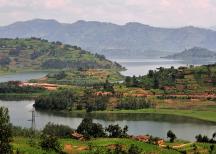
Moreover, the DRC has enough arable soil, rainfall, lakes and rivers to become the breadbasket of Africa, and enough hydroelectric power to light up the whole continent from the Cape to Cairo. While its mineral resources are so abundant that a young Belgian geologist declared the country a geological scandal at the beginning of the last century, the real scandal of the Congo include the facts that its uranium was used to build the first atomic bombs in the world and its wealth has since the days of King Leopold II been used not in the interests of its people but to the benefit of its rulers and their external allies.
Pambazuka News: Given this importance, how does this play out with regards the looming election?
Georges Nzongola-Ntalaja: The forthcoming election means more to the international community, which is spending heavily on it and even sending in European Union forces to supplement MONUC to ensure that it is being held, than to the Congolese people. The major powers of the world and the international organizations under their control would like to legitimize their current client regime in Kinshasa so they can continue unfettered to extract all the resources they need from the Congo.
Pambazuka News: What is the emancipatory role of the DRC with regards Africa’s development and what does self-determination mean in the context of this election?
Georges Nzongola-Ntalaja: The DRC cannot play a positive role in Africa’s development as long as it remains a dependent territory with approximately 60 percent of its national budget, over US$400 million for its national elections and virtually all of its development policy decisions coming from external sources. Elections, in this context, are not an exercise in self-determination but a ritual designed to justify external control through weak and non-patriotic elements of the political class. To play an emancipatory role with respect to Africa’s development, the DRC must complete its transition from colonialism to genuine independence as a sovereign nation with its own social project and capacity to make and implement its own development policies.
Pambazuka News: Historically, since independence at least, DRC has had strategic importance for the US as a result of the Cold War. Have the new dynamics associated with the war on terror changed this, and how?
Georges Nzongola-Ntalaja: On the contrary, the U.S. obsession with Islamic Fundamentalism as a potential source of terrorism makes the DRC a strategically important country because of its proximity to Sudan, its own small but significant Muslim population and its ties to East Africa, and the fact that persistent instability in the northeast is likely to provide opportunities for drug trafficking, the proliferation of small arms, money laundering and other criminal activities likely to be exploited by terrorist groups to their own advantage. The U.S. stake in the DRC is clearly evident by Washington’s involvement in the management of the current transition through CIAT (the International Committee to Accompany the Transition).
Pambazuka News: How has/does the historical legacy of Leopold 11 and Belgian colonialism impact on the country?
Georges Nzongola-Ntalaja: At the present time, Georges Forrest, a Belgian businessman, runs a big mining empire in the Katanga province, with obvious support from the Belgian state. Louis Michel, the EU Commissioner for Development and former Deputy Prime Minister and External Affairs Minister of Belgium, is one of the most powerful decision makers on the fate of the Congo. While it would be an exaggeration to put them on the same level as the agents of either King Leopold’s Congo or the Belgian Congo, the legacy of Belgian domination is kept alive through their enormous influence on Congo’s economy and politics.
Pambazuka News: What are the links between colonial rule, Mobutu and the rule of the late Kabila and now his son?
Georges Nzongola-Ntalaja: The main linkage between colonial rule, Mobutu and the two Kabila has already been underlined above, in that they each represent a predatory regime in which the enormous wealth of the country is being monopolized by the rulers and their external allies instead of serving the basic needs of the Congolese people.
Pambazuka News: You’ve written a book: ‘The Congo from Leopold to Kabila: A People's History’ in which you say that Congolese people have fought throughout their oppressive history to establish democratic institutions at home and free themselves from foreign exploitation. This is perhaps something that’s often missed in a discussion of the Congo, with a focus on war and resource extraction making it seem as if the DRC’s people are helpless in the face of these forces. Can you elaborate on your argument and how this fight has played itself out?
Georges Nzongola-Ntalaja: In January 1959, the popular masses arose against colonial rule in Kinshasa and by the end of that year, parts of the country had become totally ungovernable, leading the Belgians to conclude that they had to respect the Congolese people’s call for “immediate independence.” In 1963, faced with the evidence that independence did not meet their deepest aspirations for freedom and material well-being, peasants in the western part of the country came up with the new slogan, that of a “second independence,” and this became the rallying cry of popular insurrections led by the followers of the former and assassinated Prime Minister Patrice Lumumba, which succeeded in taking over nearly three quarters of the national territory. These insurrections were defeated by a counter-insurgency effort coordinated by the United States and Belgium, and which included the use of white mercenaries from Europe and Southern Africa.
In 1990, the rejection of the Mobutu regime through the popular consultations that the dictator himself had initiated for a verdict on his rule opened the process of transition to multiparty democracy. Had it not been for the erosion of Mobutu’s power through his repudiation by the public and which the Sovereign National Conference endorsed in 1992 through the election of Etienne Tshisekedi as Prime Minister of a transitional government, Laurent Kabila and his Rwandan allies would not have been able to march from Goma to Kinshasa in 7 months without a significant military challenge from Mobutu’s army.
Unfortunately, all these episodes of popular resistance to tyranny in search of democracy and social progress have ended in failure for lack of a political leadership that would put the people’s interests ahead of the narrow class interests of self-serving and corrupt politicians.
Pambazuka News: Any predictions for how the coming election is going to play itself out?
Georgess Nzongola-Ntalaja: Since the current transitional government has not fulfilled the requirements laid out in the Sun City/Pretoria accord for free and fair elections, the ritual of 30 July is likely to confirm Joseph Kabila as President, but it will not change the political situation of the country for the better. Violence will continue in the northeast, and corruption and incompetence will remain the most salient features of a government with an externally-driven agenda.
Interview conducted by email. Georges Nzongola-Ntalaja's book, The Congo from Leopold to Kabila: A People's History, is published by Zed Books, 2002. Georges Nzongola-Ntalaja is Facilitator for the Africa Governance Institute (AGI), a project of the Regional Bureau for Africa of the United Nations Development Programme (UNDP) in New York. He has also served UNDP as Director of the Oslo Governance Centre in Oslo, Norway, from 1 August 2002 to 31 July 2005, and as Senior Adviser on Governance to the Federal Government of Nigeria in Abuja, Nigeria, from March 2000 to May 2002.
* Please send comments to or comment online at www.pambazuka.org
- Log in to post comments
- 3441 reads
Author

Anonymous (not verified)