

















Emira Woods points out that “Yet as in many communities in Nigeria’s oil rich Delta region, most people of Yenagoa live in mud huts. Some reside only a few feet away from the oil wells. But they lack electricity and indoor toilets. They have no hospitals, no running water, no schools. And there is unemployment too. Oil companies like Royal Dutch Shell, BP, Chevron, and Exxon Mobil bring in foreign workers for even the most menial jobs. ... Like many Africans, I fear that oil companies look to Africa for its resource wealth without seeing the people. Resource-rich communities are dehumanized and the color-line is ever present as the greatest profits flow steadily to wealthy white men who already control enormous wealth and power.”
It is almost impossible to imagine, as we sit in a well lit, fully functioning gas station on Main Street, USA, that a community blessed with oil riches under its soil could look as impoverished as Yenagoa in the Nigerian state of Bayelsa.
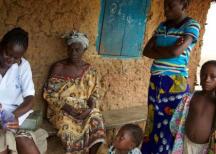
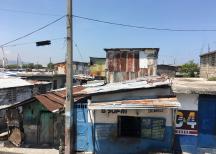
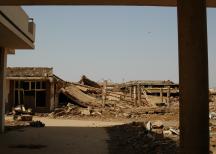
Yenagoa is the site of one of Nigeria 's first oil wells, built in pre-independence 1956. Yet as in many communities in Nigeria’s oil rich Delta region, most people of Yenagoa live in mud huts. Some reside only a few feet away from the oil wells. But they lack electricity and indoor toilets. They have no hospitals, no running water, no schools. And there is unemployment too. Oil companies like Royal Dutch Shell, BP, Chevron, and Exxon Mobil bring in foreign workers for even the most menial jobs.
I recently took a trip to Yenagoa as part of a tour of three African countries--Nigeria, Chad, and Liberia-- that may well fuel future U.S. energy needs. Historically, the United States has gotten two-thirds of its oil from other countries. Most U.S. oil imports come from Saudi Arabia, Venezuela, Mexico, and Canada. Increasingly, as the United States, China, and other nations expand their thirst for oil, and instability deepens in the Middle East, Sub-Saharan Africa is becoming a more attractive source for crude. The U.S. National Intelligence Council estimates that Africa could supply 25% of U.S. oil by 2015.
The three countries I visited could well play a role in meeting that goal. Each is at different stages of oil production. In Nigeria, oil exploration dates back to 1956. In Chad, extraction started just three years ago. In Liberia, where I spent much of my childhood, the potential of oil off its expansive coastline holds hope for the future.
In each of these countries, a complex web of geo-political actors, from oil company executives and government officials to military agents, makes decisions that impact the lives in the communities that produce the oil that flows straight to consumers in the United States.
Nigerian Injustice
The residents of Yenagoa lack jobs and basic social services. What they do have in abundance is environmental damage from decades of oil spills, compounded by the constant burning of gas flares necessary to extract the crude. Farmland is rendered useless while rivers and waterways, once well populated with marine life, are now barren. One local chief explained that he received from Shell oil 150 Naira ($1.15) for each acre of land used by the company. I was astonished when he went on to say, “150 Naira, once every four years.” With oil prices at historic highs, how could the compensation to communities long suffering the health impacts of oil spills and gas flares be such a pittance?
Military and security personnel blanket the area around Yenagoa to protect oil interests. The communities are under siege.
In Odi, a community adjacent to a well built in1958, villagers are demanding basic services like clean running water, electricity, and schools. The response from security agents has been severe. Our delegation watched in horror as one young man after another came forward to show fresh wounds from 5 days earlier. They told us that uniformed military men had grabbed 15 youths as they walked home from an adjacent village in the middle of the afternoon. The young men were beaten, tortured, and imprisoned, as a warning to others in the village. For almost a week, the youths languished in a prison miles away. Their family members were forced to walk for a day and a half to see them or bring them food in that decrepit prison. Their crime? Clamoring for basic rights.
As oil companies celebrate record profits and the price of oil hovers close to $65 per barrel, African communities ostensibly blessed with the curse of oil languish in squalor. In fact, with no useable farmland or waterways, many in Nigeria say that they are worse off than their grandparents were before the discovery of oil.
Hope in Chad?
Recognizing the plight of their neighbors in Nigeria, communities in Chad’s oil producing areas worked hard, even before the onset of oil production in 2003, to minimize environmental damage and maximize the benefits to communities from which the oil flows.
The 650-mile Chad-Cameroon pipeline (Africa’s biggest investment project) links landlocked Chad to world export markets through Cameroon’s port city of Douala. It was funded through loans and other support from the World Bank. Heroic measures initiated by activist, civil society, human rights, and religious community leaders led to a forward-looking revenue management law to manage the flow of oil revenues in a transparent way, ensuring resources for future generations.
However, the Chadian government has subverted its own revenue management law. It has diverted spending away from the original priorities of agriculture, health, and education and toward “security.” As a result, money that only now is beginning to flow from oil production is spent on weapons and other military equipment, instead of poverty reduction and the interests of future generations.
The oil wells in Chad are newer, so its oil-producing areas haven’t yet experienced the damage caused by decades of oil spills. However, gas flaring, with its related health and environmental damage, is an integral part of the production cycle. When the wind blows, the smell of the burning gas blankets villages miles away.
In a community near Doba, with gas flares as a backdrop, villagers told us about increased death and dying in the past few years from respiratory ailments and contaminated water supplies.
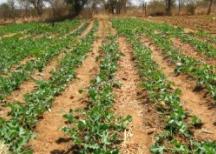
Meanwhile, in Chad’s fertile agricultural zone, mangoes, cotton, gum Arabic and cattle are abundant. Yet there is not one factory transforming the raw produce into goods for domestic or international markets.
In spite of these challenges, Chadians maintain that their vigilance will minimize negative social and environmental impacts of oil and secure poverty reduction. Chad could easily feed itself and its neighbors if productive capacity were built in the agricultural sector. Oil revenue directed at building an education system, providing healthcare, as well as basic electricity, running water, and roads, could go a long way toward improving the condition of people’s lives.
Throughout the country, in spite of a recent coup attempt and the elections in April that the majority of people boycotted, Chadians remain hopeful. From the capital city to the Southern oil fields, everyone seemed confident that future generations will experience a better life.
Liberian Alternatives
Liberia, the third country I visited, has recently emerged from 25 years of war. People there are hopeful too, despite the 85% unemployment rate and the complete lack of functioning schools or healthcare.
Liberians hope that concessions now being granted for off-shore oil exploration will lead down the road to a new source of revenue. Liberia’s National Oil Company negotiated two contracts with the Nigeria-based Oranto Petroleum Limited and British-based Broadway Consolidated PLC. With exploration already underway, few in Liberia think that leaving the resource untouched is a viable option.
The key question is, whether and how Liberia can escape the oil curse that so clearly has hurt Nigeria, Angola, and other countries in Africa’s richly endowed Gulf of Guinea region.
One possibility is for countries like Liberia to consider alternative models for oil development. What, for example, can Liberia learn from Venezuela’s example of 61% national control of oil revenue and management? Or from Norway’s use of oil revenue to diversify the economy while advancing social services?
Like many Africans, I fear that oil companies look to Africa for its resource wealth without seeing the people. Resource-rich communities are dehumanized and the color-line is ever present as the greatest profits flow steadily to wealthy white men who already control enormous wealth and power.
The price of oil nearly tripled since President George W. Bush took office in 2001, yet the majority of the people who live in the countries from which the fuel flows still experience grinding poverty. Taken together, the $10 billion quarterly profits of Exxon Mobil, Chevron, BP, or Shell and the $1.15 per acre compensation paid (every four years) to some farmers in oil producing zones, show just how unfair the global oil industry has become.
The next time you pull up to the pump, stop a moment and remember that the thick black crude is extracted from the earth’s crust at great social, political, and environmental cost. Then do whatever it is in your power to demand dignity and proper compensation for those whose land or sea may be cursed with the blessing of this natural resource.
* Emira Woods is co-director of Foreign Policy In Focus at the Institute for Policy Studies.
* Please send comments to or comment online at www.pambazuka.org
- Log in to post comments
- 2052 reads
Author

Anonymous (not verified)