
















Freedom songs ‘speak to the pertinent issues of the time, expose the excesses and injustices of the system and the comfortable beneficiaries and supporters of the system, and point to the type of society the people envisage and the means to attain it,’ writes Mphutlane wa Bofelo. That is why South Africa’s new political elite is ‘stunting’ the ‘creative imagination and revolutionary rhythm by harping on “yesterday's” songs’, says Bofelo, so that it can deflect the growing anger among the masses about the failings of their leadership back onto the ‘remnants of the old order’.
The debates around ANC Youth League leader Julius Malema’s singing of the song ‘Dubula bhunu’ – meaning ‘shoot the Boers’ – which also contains the lyrics: ‘these dogs are rapists’, says a lot about efforts to deflect the attention of the people away from composing new struggle songs that capture the contradictions, complexities and vulgarities of the time and moment, place and space that is neo-apartheid, neocolonial, neoliberal capitalist South Africa.
Freedom songs (proper) speak to the pertinent issues of the time, expose the excesses and injustices of the system and the comfortable beneficiaries and supporters of the system, and point to the type of society the people envisage and the means to attain it. They cause discomfort to those holding the reigns of political power as well as those who control the economy, and provide morale and hope to the struggling masses. Freedom songs also celebrate the victories gained on the terrain of struggle and take a dig at any act of deviation from the original goals of the struggle, as well as any reactionary project of revisionism.
A vigilant civil society will also coin slogans and songs that rile against cooption by the system or against the abuse of struggle platforms and the arbitrary change of the goals of the struggle by the political elite. In our case, there has been a deliberate stunting of the creative imagination and revolutionary rhythm by harping on ‘yesterday's’ songs without attuning them to current realities. It is true that in the freedom songs and slogans, it had become tradition to use ‘Boers’ as a kind of generic terms to refer collectively to people who benefited from and actively supported the system of Apartheid-Capitalism to the point where people had come to use the terms ‘Boers’ and the system inter-changeably. It was therefore not unusual to hear people chant ‘Pansi na Mabhunu’, and in the same breath sing songs of praise to Bram Fischer, Joe Slovo or vouch by Marx, Engels, Lenin and Trotsky. Sometimes there would be white people – Afrikaner, English, Jewish – in the audience, also partaking in the singing and chanting. The understanding was that exceptions don’t render the general situation or the rule obsolete.
Everyone who had undergone proper political education knew that the problem in South Africa/Azania was with capitalism as entrenched and fostered by racialism, and with racism as consolidated and ingrained by capitalism. We knew that white superiority complex and Black inferiority complex and unequal power relations and inequitable socio-economic relations anchored on race and class were not an act of nature. We therefore believed that this could be brought to an end by a radical reconstruction and transformation of the allocation and distribution of power and resources. We also knew that it does not only take a white skin to install or perpetuate a system based on unequal allocation of power and inequitable distribution of wealth and resources. We knew that the struggle for justice is not determined by the colour of the one who holds political office; that individuals’ politics and economics and class positions are not solely influences and determined by the colour of skin or the texture of hair.
That the political, social and economic conduct and morality of a person is not ultimately informed by his or her ‘race’ and that our judgment of what is morally and politically unacceptable should not be the race or gender of a culprit and victim. In other words, we had learnt to differentiate between generalising about the collective conditions of black and white people and endorsing stereotypes about black and white people. We knew that there were black people who have been bought into the system and white people who are conscientious dissidents and anti-apartheid activists.
We knew that our country could either reform or transform power and social relations anchored on the marriage between class and race, that post-apartheid South Africa could either be a complete break with apartheid-capitalism or be a surface modification of the old society. We also knew that we then would have to attune our forms of struggle, our activism and our slogans and songs accordingly.
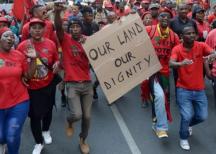
The new political elite also knows that ultimately this is what the masses would do. They have already heard in some marches the masses sing: ‘Amabhunu amnyama asenzela i- worry’ – ‘Black Boers cause us worries.’ Their harping on ‘struggle songs’ as they were sung in the past, is not a reflection of how attached they are to the struggle, but an attempt to locate the struggle literally in the past. They want us to believe that the struggle is over, that all we have is remnants of the old order against whom our anger should be vented. In this way, the political elite sidetracks us from singing about the current dislocation of water and electricity, the ruthless and violent evictions of shack dwellers by the red ants, the vicious police attack on service delivery protesters, the financial exclusion of students, the kleptomaniac proclivities of the new political and economic elite, the advent of the black colonialists, attacks on the freedom of media, the massive acts of de-politicisation, de-historicisation of our struggle and concerted efforts towards de-memorialisation.
While race continues to be a very important issue, the black political and economic elites raise race not to confront racism but as a card to render themselves immune from criticism and also to find a slice for themselves in the economic cake. It is a weapon of mass distraction to fail to point out that the economy remains in white hands precisely because the ‘guarantee of property rights’ and ‘protection of minority rights’ where part of the Kempton park package and precisely because the ruling African National Congress believes that there is no alternative to unbridled capital.
Jacob Zuma went to Britain and assured the masters that the ANC never made mistakes when it designed its policies, and that nationalisation will not happen. Malema himself told the press recently that by nationalisation the ANC Youth League only means private-public partnerships. Yet, the same man who makes it clear that the land and the mines are not going to be socialised under ANC government, leads us into singing ‘Dubula bhunu’. If it is our government that maintains the property regime established by apartheid-government, why should our guns be indiscriminately directed towards the Boers? Why aren't our machine guns directed towards the bourgeoisie – black and white? Why shouldn't our attack on capitalism be as vicious as our attack on racism? It is simple; the ranting against Boers and ugly women is to take attention away from the songs of the protesting people in the streets of Sharpeville, Bulfour, Harismith… multitudes of people whose life is a nightmare under the rainbow-nation mirage.
The theme songs of Malema and Zuma are subtle attacks on the creative imagination and revolutionary urge of the masses. They want to focus the people on imaginary fights with the Boers while the filthy rich black political and economic elites are involved in equity deals with the stinky rich whites, strolling half-naked with them in exotic beaches and exclusive resorts. What we need are slogans and songs that highlight that we live in an environment where the ruling party consists of the black majority, in which the black political and economic elite have been co-opted into the capitalist machinery and is responsible for the design and implementation of policies and practices that entrench and perpetuate the structural and systemic socioeconomic disenfranchisement, exclusion, disempowerment, underdevelopment and marginalisation of the black majority. We do not need empty radical posturing and racist ‘scapegoating’. We need slogans and songs that will unlock the creative imagination and revolutionary pulse of the masses and make them think and act outside of the box in search of solutions to the many problems and challenges facing them.
BROUGHT TO YOU BY PAMBAZUKA NEWS
* Mphutlane wa Bofelo is a cultural worker and social critic.
* Please send comments to [email protected] or comment online at Pambazuka News.
- Log in to post comments
- 4712 reads
Author

Anonymous (not verified)