













As South Africa’s Freedom Day rolls around each year, it has become something of a cliché for pundits and politicians to observe that while the country has political freedom, the majority of its people have yet to attain economic freedom. But this platitude masks an extraordinarily anaemic view of political freedom, writes Richard Pithouse.
‘Freedom only for the supporters of the government, only for the members of a party – however numerous they may be – is no freedom at all.’ – Rosa Luxemburg, Berlin, 1920.
The assumption that political freedom begins and ends with the right to vote runs a real risk of overlooking escalating grassroots repression, the general conflation of the party and the state and the damage that is done to society by the wholly incorrect assumption that the economic realm is separate from the political realm and governed only by technical considerations.
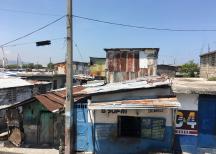
Of course it is true that millions of people continue to have to make their lives in the most appalling material circumstances. And it is also true that, by some accounts, we are now the most unequal country in the world. It is outrageous that so many children are being put to bed on empty stomachs in leaking shacks at constant risk of fire and violent eviction. The excesses of private and state power compound that outrage. Gated communities for the rich continue to take the best land while the political elites find it impossible to provide toilets to the poor but can easily mobilise the political will to throw up new stadiums.
But the so obviously bitter realities of economic oppression should not blind us to the fact that political freedom was never completely realised in post-apartheid South Africa. The genuine flowering of political freedom enjoyed by the middle classes and elites after apartheid was never fully extended to the poor. Everyone has been free to vote but there are many communities across the country where there has never been freedom to organise independently of the ANC. There are communities where open opposition to the ANC puts one at the risk of expulsion from the community and there are communities were taking a position against the ANC puts one at real risk of violence.
This kind of aggressive political intolerance tends to be organised at the local level and in defence of local political interests. It is for this reason that local government elections are a far more dangerous time for grassroots critics of the ANC than national elections. The situation appears to be particularly bad in Durban and the 2006 local government elections were certainly not free and fair in that city.
There were two grassroots challenges to the ANC. In E-Section of Umlazi, a group of people with solid links to MK (Umkhonto we Sizwe), the SACP (South African Communist Party) and civic and trade union struggles decided to run an independent candidate against the incumbent ANC councillor. In the Northern suburbs on the other side of the city, the shack dweller’s movement Abahlali baseMjondolo decided to stage a boycott under the banner of ‘No Land! No House! No Vote!’
The local ANC described the people behind the independent candidature in Umlazi as ‘reactionaries hell bent on destabilising the ANC.’ Over a period of three months, four people involved in the campaign for the independent candidate were assassinated and another was seriously wounded in an attempted assassination.
The Abahlali baseMjondolo election boycott resulted in the movement being declared a ‘third force hell bent on destabilising the country.’ Their marches were unlawfully banned, an attempt to march in defiance of an unlawful ban was met with severe police violence resulting in serious injuries and the police were even used to physically prevent the movement from taking up an invitation to debate the eThekwini mayor live on television.
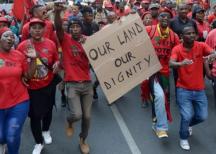
For the last five years Abahlali baseMjondolo have organised an annual ‘UnFreedom Day’ on 27 April to mourn their lack of political freedom. But the situation in Durban has worsened since 2006. In March this year, Cope supporters were burnt out of the kwaShembe settlement in Claremont and in September last year Abahlali baseMjondolo was evicted from the Kennedy Road settlement in Clare Estate by an armed mob openly backed by the police and the ANC. The ANC has simply ignored calls for an independent and credible inquiry into the ongoing violence in the Kennedy Road settlement. The middle classes can look forward to free and fair local government elections next year but there are no grounds to assume that the same can be said for the poor.
The second problem with the cliché about economic freedom needing to catch up with political freedom is that political freedom is being steadily constrained across society as the ANC lumbers, step by step, towards an increasingly authoritarian conflation of the party and the state. The steady chipping away at the rule of law, the entrenchment of corruption as a key mechanism for patronage within the party, secretive party funding and the party’s brazen abuse of its position to advance its own business interests all add up to a steady diminishment of political freedom in general. Liberal democracy operates on the assumption that parties represent competing constituencies within the electorate, but the fact of the matter is that the ANC has become an organisation with its own interests.
And, of course, freedom is not only about the right to organise nor is it only at risk from political elites. The general turn towards social conservatism with its sexism, homophobia, ethnic chauvinism and xenophobia are a serious assault on hard won principles that affirm, at least in principle, the equality and sanctity of every person.
But the limits to political freedom are not merely the set of our failures to live up to the commitment to constitutional democracy. All of the constitutional protections for political freedom need to be defended – but they are not, on their own, enough. Liberal democracies are unquestionably preferable to authoritarian states but they have a structural bias towards to the rich and the powerful. Party funding mechanisms, the ways in which elite interests are able to lobby policy makers, the substitution of professionalised civil society for popular organisation and the fact that the legal system is so profoundly commodified, are just some examples of the many ways in which liberal democracies have an entrenched bias towards the rich.
The only way to reduce this structural bias is via sustained popular organisation that can enable ordinary people to begin to subordinate the political class to the popular will. This kind of popular organisation may or may not take the form of contesting elections, but it certainly has to resist any attempt to limit it to electing representatives under top down party discipline. On the contrary, if popular organisation is to have any chance of creating a structural shift in power relations, it has to be an ongoing practice of freedom rooted in ordinary people’s ordinary lives. Once this has been achieved, even to some degree, it starts to become possible to drag the economic realm back into the social realm with the result that political freedom can begin to produce real economic freedom.
In recent years there have been important but highly contested experiments in popular democratic practices in places like Haiti and Bolivia. It is one of the great tragedies of our country that the ANC has chosen to respond to similar experiments on a much smaller scale in our society with repression rather than encouragement. Any political party or organisation that does not encourage oppressed people to organise themselves for themselves is an enemy of freedom.
BROUGHT TO YOU BY PAMBAZUKA NEWS
* This article first appeared on The South African Civil Society Information Service.
* Richard Pithouse teaches politics at Rhodes University.
* Please send comments to [email protected] or comment online at Pambazuka News.
- Log in to post comments
- 4298 reads
Author

Anonymous (not verified)