











Although their top leaders were recently feted internationally, Tunisians are restive due to high unemployment and insecurity. Many feel life was better under President Ben Ali prior to the 2011 Arab Spring
Last week, both the Tunisian caretaker President Dr Moncef Marzouki and the president of the ruling Islamist Movement, Rachid Gannouchi , were in London to receive the ‘2012 Chatham House Prize’. Chatham House is a leading London based International Affairs think-tank. It said that it decided to award the two for their ‘role at the forefront of the new democratic wave in the Middle East and North Africa’. The Chatham House award is presented annually to the statesperson deemed to ‘have made the most significant contribution to the improvement of international relations.’ Dr Marzouki was also named by the American ‘Foreign Policy’ magazine as the world’s second most influential thinker in 2012 in their annual list, also published last week.
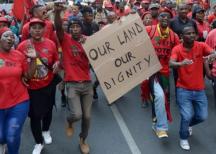
Ironically and only a few days after the award was given, violence broke out in the governorate of Siliana in the North West of Tunisia, as protesters took to the streets, decrying the very same economic conditions that spurred violence in early 2011 and subsequently led to the fall of former President Ben Ali.
More than 250 people were injured, some severely. Security forces used tear gas and rubber bullets to disperse protestors, with reports of people being treated for gunshot wounds. Tension has been brewing in Siliana, which is about 120km south of the capital Tunis, and in many other parts of the country. The residents of Siliana went on a general strike, angered at the mayor’s failure to deliver on promises to create jobs, and called for his resignation and the resignation of the cabinet. In many parts of the country, people are disappointed by the lack of progress following their uprising. Unemployment has risen sharply and essential food prices have also gone up dramatically in recent months. Tunisia's economy, based in large part on European tourism and exports, has suffered after the uprising and with the European economic crisis. On 27 TuesdayNovember , the World Bank approved a $500 million loan to help support reforms in the financial sector to encourage investment and growth.
Siliana’s residents also called for the release of 14 people who were arrested nearly two years ago and are still being held without trial. The protests were the fiercest since hard-line Salafi Islamists attacked the U.S. embassy in Tunis on 12 September over an anti-Islam film made in the USA. That violence left four people dead.
Tunisia is the birthplace of the ‘Arab Spring’ and its democratic process is considered hugely successful and a model for the rest of the Arab world. However, most Tunisians have been talking of the need for a ‘revolution after the revolution’. The caretaker president himself spoke early in his presidency of having ‘nightmares’ of a second revolution. When I asked him what he was doing to address the increasing levels of poverty, unemployment, disease, and an unprecedented level of illegal immigration to Europe via Italy, he replied that he worked day and night alongside the Prime Minister to tackle those issues, and that given the legacy left by the previous government, it would take time, patience and perseverance to meet such challenges.
Dr Marzouki is the first elected President by the country’s constituent assembly in a power-sharing deal between the centre-right Ennhada, Marzouki’s centre-left Congress for the Republic(CPR) and centre–left Ettakattol, a coalition known as the Troika. But the Troika has been facing challenges even within its members. Their differences have been known to the Tunisian public. Its major challenge was over the extradition of the former Libyan Prime Minister back to Libya for trial last June - a decision taken solely by Ennahda’s prime minister and that angered President Marzouki who insisted on a guarantee of a fair trial first.
A former doctor and a human-rights activist, Dr Marzouki is adamant that authoritarianism is a ‘disease’ which must be treated. Addressing members of the Tunisian community in the UK, Dr Marzouki stressed the imperative to hold elections in the early summer of 2013 in order to get the country on track. . He also highlighted the need to avoid ideological conflicts. ‘Tunisia,’ he said, ‘is a real laboratory where peaceful democratic transition is being tested and political players co-exist in a context of coalition and consensus’. He expressed his optimism that the Tunisian experiment would be a successful one.
Many Tunisians, however, are skeptical. They say the future of their country seems bleak. With the recent events in Siliana, they say their country is far from being peaceful or stable and are concerned about what they consider the rise of a new dictatorship in the shape of the current government, and one that’s willing to use worse practices than the previous one to oppress and silence dissent. They are also concerned about the killing of members of prominent opposition parties in mysterious circumstances, the imprisonment of journalists without trial and the increasing polarisation of society around religion.
A recent survey showed that 42 per cent of Tunisians believe that life was better under Ben Ali. They say at least under him, there was security, the economy was functioning and the ultra religious groups did not exist and if they did, did not represent a real (threat?). On social networks, many express their regret for asking Ben Ali to ‘degage’- (to go), saying it was a joke on their part!
* BROUGHT TO YOU BY PAMBAZUKA NEWS
* Please do not take Pambazuka for granted! Become a Friend of Pambazuka and make a donation NOW to help keep Pambazuka FREE and INDEPENDENT!
* Please send comments to editor[at]pambazuka[dot]org or comment online at Pambazuka News.
* Mounira Chaieb is a Tunisian journalist based in London, and formerly worked for the BBC.
- Log in to post comments
- 1678 reads
Author

Anonymous (not verified)