



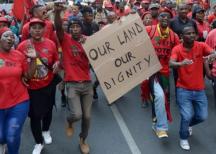




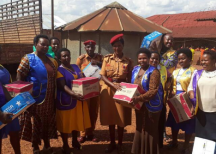



















Food production systems in Africa are founded on values centered around incomes and profitability that Nidhi Tandon challenges. Unless and until the over-emphasis on the values that underpin the global market economy is reversed, equality and equity for women is doomed.
If there is one core factor underpinning systemic power imbalances between women and men in the food system, it is the overriding influence of the ‘market place’ on society. Societal power and earning capacity make up the two sides of the same coin – one feeds the other. The more financial leverage one has, the more likely one is to project power: gain voice, respect, independence, and the ability to negotiate terms and indeed get a more favourable hearing before a court of law. This sounds simplistic, even glib, but it is a reality that especially affects women. The rights that women have fought to secure are under siege by the dominance of a globalized market society.
One approach to enhancing women’s power, supported by Oxfam, is to position women ever more ‘strategically’ into the ‘value chain’ of globalized production, on the assumption that if only they had the opportunity to earn the equivalent of their male peers, they might earn an equivalence of power and influence. In so doing, a fundamentally flawed food system is being further ‘propagated’, in effect out-casting other food systems.
Women are generally solid about their pivotal role in securing daily food and water. But when they join global supply chains, women, like men, become complicit in a livelihood system that keeps the family in a state of permanent impoverishment.
From my conversations with women in rural communities, it is apparent that they would like to see their roles properly dignified, valued, acknowledged and supported.
This is not about ‘fixing a broken food system’; it is about changing the model and its values entirely. We cannot assume that women are seeking high incomes at any cost. They don’t necessarily share those values! Other values are much more important – including health, food, consumption or other lifestyle choices; these are the values that need to be weighted heavier than earning income.
VALUES AND THE TWO PARALLEL FOOD PRODUCTION SYSTEMS
At the extreme ends, there are two parallel systems of food production: one values sustenance and nutrition, the other values profits. In the food system that is primarily about local production for local markets, the decisions and to some extent the control over what is grown, distributed, cooked and consumed rests with women. They deliver a steady supply of sustenance and nutrition despite lacklustre public or private-sector support.
Seed preservation continues to be an important activity of rural women, ensuring that families have a wide variety of foods which are entirely outside the market. Their land-use decisions are bound up with secure employment and with agro-biodiverse ways of farming in a symbiotic relationship with water, forests and nature’s biomes.
In the parallel food system at the other extreme, women are but cheap labour in commercial enterprises at scale. Plantation workers, who have tended to be male although increasingly female, work in unprotected conditions and are impoverished. Family and community life is disrupted by the violence of displacement and evictions that plantations cause. [1]
EARNING INCOME IS NOT NECESSARILY EMPOWERING
A common argument put forward by those seeking equality between men and women goes like this: ‘poor rural women need equal employment opportunities to earn income for medicines, education, food and clothing and to become economically empowered.’ The problems with this argument are:
To begin with, inserting a small farmer into the commercial exchange system of the international market is exploitative to the farmer no matter what. They are not, in the scheme of things, economically empowered.
Secondly, taking the best farmland away from cultivation for local consumption and converting that land to farming for export puts local people in a situation of dependence on a profit-motivated market over which they have absolutely no control. With this dependence comes vulnerability.
Thirdly, the international economic model does not work for small farmers. Consistent evidence [2] shows how market liberalization has been designed to benefit the rich while poor people simply do not matter.
If in the course of earning income, you can expect to be systematically exploited, have decision-making choices over what is grown and how taken away from you, and be left with denuded natural environs, then this is a heavy price to pay for so-called empowerment.
ARTICULATING A VISION – CHANGING VALUES
Unless and until the over-emphasis on the values that underpin the global market economy is reversed, equality and equity for women is doomed. For men’s and women’s roles to be rebalanced in a just food system, other values must be reasserted on an equal if not dominant footing: societal perceptions must equate ‘power’ with the know-how of doing as opposed to the know-how of selling and buying.
When traditional knowledge, science and common sense are combined on the farm, and the roles of both men and women in building smart communities around food are re-established, there is much more of an imperative for mutual respect between men and women. Where farmers supplying local markets invest time and labour (and equity in terms of care and energy) in a diverse set of activities – the socio-economic, community and ecological rewards are far higher than any financial transaction returns.
This reversal of values can only take place at a human level; money cannot be thrown at it. It is inter-generational work that places a central value on enviro-cultural relationships between humans and the lands that they inhabit, a movement that reinstates values from one village to the next, from one community to the next. These relationships are essentially priceless – and the sea-change needed to retain and change perceptions of values needs to happen on many different levels, from education systems to the politics of trade and investment. [3]
If we are willing to stand by only the principles of gender equality and by extension accept and even determine that the fate of poor women should be equal to that of their poor male counterparts, then there is something fundamentally amiss in our interpretation of human rights and development. The problem is larger, systemic, and structural. It is not reducible to individual rights.
The values that underpin the food system today are about food for profit, as opposed to food for those who produce it! The conversation needs to begin with a national reassessment of how globalization is impacting society rather than pushing for women to be inserted into an iniquitous system, and what it will take to thrive and to protect what is important in a rapidly changing world – where the winners take all and the losers have everything to fight for.
ENDNOTES:
1. Several studies show how the contract labour system is responsible for family breakdown; increased alcoholism, drug use and crime; the proliferation of sexually transmitted diseases including HIV AIDS; as well as perpetuating a cycle of poverty that entrenches poor nutrition, inadequate education, and illness. All of these factors reinforce each other and the negative costs on community are enormous and long term.
2. The 2000 Trade and Hunger series give ample testament to this fact – see http://www.grain.org/article/entries/212-trade-and-hunger
3. Farida Akhter: Seeds in Women’s Hands: A symbol of food security and solidarity Food security in Development 2001 The Society for International Development. SAGE Publications (London, Thousand Oaks, CA and New Delhi)
* BROUGHT TO YOU BY PAMBAZUKA NEWS
* Please do not take Pambazuka for granted! Become a Friend of Pambazuka and make a donation NOW to help keep Pambazuka FREE and INDEPENDENT!
* Please send comments to editor[at]pambazuka[dot]org or comment online at Pambazuka News.
* Nidhi Tandon is originally from East Africa and is based in Toronto, Canada where she works as an independent consultant. Nidhi is a social activist, animator and writer working with women and with marginalized communities to raise their voices in a globalized economy.
- Log in to post comments
- 3413 reads
Author

Anonymous (not verified)