






















While the achievement of universal ontological rights in South Africa has been a marvellous step forward, writes Jason Hickel, the paradigm of a rights-based revolution is seriously and fundamentally flawed, and cannot serve the ends that South Africa intends it to. Cautioning that the state can grant people discursively constituted rights with one hand and strip them of the conditions for sustainable life with the other without ever having to confront the contradiction, Hickel says it’s time to reclaim the heritage of the commons.
‘But we can’t eat rights, hawu!’ Those five words of protest that usher from the lips of South Africa’s underclass sting like a slap in the face. Good liberals will always take offence. We find ourselves scrambling desperately to battle the mad claim that ‘things were better under apartheid.’ ‘But of what worth is a job,’ we retort, somewhat lamely, ‘within a society that defines you as ontologically subhuman?’
The impulse to defend South Africa’s political transformation kicks in like a reflex because we assume the critique to be reactionary, aligned with the propaganda of the old guard, a sure sign that minds remain colonised 15 years after liberation. But it’s not. It’s not a thoughtless dichotomisation of bread against freedom. Alongside the expression of profound disillusionment, this off-hand remark carries an insipient but radical critique of the ‘rights’ paradigm that furnished the parameters for the revolution.
It has become a leitmotif in South African political analysis to point out that something about the revolution went terribly, nightmarishly wrong. The people have seen the hopes they inscribed in the Freedom Charter cruelly dashed, have felt their families crushed by endemic joblessness and their aspirations thwarted by a failing education system, and all the while they have watched – bewildered – as glitzy malls rise like tides and the roads swell thick with luxury vehicles. It’s no wonder they want to spit out their rights with contempt like so many shards of glass. Fake jewels. A trick. That’s what betrayal feels like.
But how did this happen? How did it all come to this? The pundits are right to assert that the dawn of democracy left the basic class structures of colonialism and apartheid in place. They are correct to note that the negotiated transition, led by technocrats behind closed doors, left the banks, the mines, and the land – all the levers of true power – in the hands of private capital interests. Most of us accept the claim that initiatives like Black Economic Empowerment simply change the hue of the elite but fail to bridge the class inequalities that they pretend to redress.
By fetishising race as the object of revolutionary intervention, the state conveniently sidelines substantive questions of class. We know this. It’s all over the papers, part of the common parlance. Yet nothing changes. The reformers insist that the failures we sense are due merely to problems of implementation, that ‘rights’ are the solution to social inequality. South Africa has the most progressive constitution in the world, they remind us: It’s just a matter of realising the rights that all citizens have been assigned. If we can manage to beef up bureaucracy and expand service delivery, all will be well; the revolution lies therein.
If only it were so simple. In fact, it’s not a question of implementation at all; the pundits have it quite wrong on that point. The real issue is that the whole paradigm of a rights-based revolution is seriously and fundamentally flawed, and cannot serve the ends that South Africa intends it to. Human rights discourse acts as handmaiden to neoliberal economics because rights are – at base – registered in an individual-ontological domain rather than a collective-material one. The state can grant people discursively constituted rights with one hand and strip them of the conditions for sustainable life with the other, without ever having to confront the contradiction.
In this sense, ‘rights’ are a safe reformist option for a capitalist state with a progressive image to maintain. In South Africa, the elite class interests that underpinned apartheid were all too happy to grant this concession because it allowed them to keep their wealth intact; in fact, it allowed them greater latitude for exploitation. The same sleight of hand applies today, a masterful trick of legalese that shifts attention from economy to ontology, depoliticises protest by talking up service delivery, and quells discontent by casting a discursive veil of protection over the poor.
The trick consists in the conceptual slippage within the language of rights. There are two basic kinds of rights. Fundamental human rights – such as universal franchise and freedom from discrimination – recognise the ontological equality of all citizens. These rights are non-derogable and limitless in their application. For example, the state can grant everyone the right to speech because speech is not a limited resource. Socio-economic rights, however – such as rights to water, food, and housing – are only ‘progressively realisable,’ according to the constitution, and limited by the resources that the state has at its disposal. It is this latter specie with which I am concerned here. The trouble is that it registers in the individual-ontological domain, so that each individual ‘has’ equal rights to water in the same vague, transcendental sense that each individual ‘has’ equal rights to speech.
But the homology makes no sense. Speech and water are two completely different things. Each citizen can exercise the right to speech without impinging on the speech rights of all the others. This does not hold for water, however. If one citizen exercises rights over water in a certain area – if, say, he owns the land from which it springs – he might preclude others from exercising their own rights to water. The same goes for privatised food, housing, and healthcare. Liberty and equality thus exist in constant, irreconcilable tension.
The point is that the individual-ontological structure of ‘rights’ simply will not work for the socio-economic transformations that South Africa is trying to achieve. When it comes to things like water and jobs, we need a fundamental paradigm shift, a transition from the notion of ‘rights’ to the concept of ‘commons.’ Hints of this hide in the Freedom Charter. About natural resources it states, in paraphrase: ‘The national wealth of the country shall be restored to the people, and industry and trade shall be controlled to assist their wellbeing.’ Such words do not rely on the discourse of individual rights. Nor do they hail the spectre of command communism. Instead, they assert the simple point that none have the right to possess and accumulate that which society holds in common. Upholding this basic principle would not mean the abolition of private property or industry, but merely that certain public goods must be understood as commons, and that protections, profits, and benefits should accrue to people accordingly.
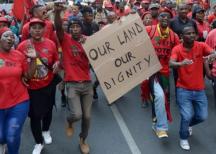
Let me be clear: The achievement of universal ontological rights in South Africa has been a marvellous step forward. But it’s time to extend our minds beyond this frontier, to reclaim the heritage of the commons. Rights and service delivery will not save South Africa from the social instability toward which it is rapidly plummeting. While the technocrats shout from the parapets of the union buildings ‘Let them eat rights!’ the people burn tires in the streets below, proclaiming through the flames that they will not be tricked, that history has not yet met its end.
BROUGHT TO YOU BY PAMBAZUKA NEWS
* Jason Hickel is a researcher at the University of KwaZulu-Natal and an instructor and doctoral candidate in the Department of Anthropology, University of Virginia.
* Please send comments to [email protected] or comment online at Pambazuka News.
- Log in to post comments
- 1523 reads
Author

Anonymous (not verified)